
Jimmy White 6-5 Matthew Stevens: International Championship Qualifying and the Limits of a 64-Year-Old Legend
**Câu trả lời cốt lõi**: Jimmy White, 64 tuổi, đã vượt qua vòng loại International Championship 2026 sau khi hạ Matthew Stevens 6-5 ở thể thức best-of-11. Kết quả phản ánh ưu thế của thể thức ngắn đối với tay cơ kỳ cựu, không phải sự hồi sinh phong độ dài hạn. **Dữ kiện chính**: - Tỷ số: Jimmy White 6-5 Matthew Stevens; White dẫn 5-2 rồi bị kéo về 5-5. - Break cao nhất: Matthew Stevens 121 và 72; Jimmy White 104 (century thứ ba trong mùa). - Jimmy White 64 tuổi, tay cơ lớn tuổi nhất World Snooker Tour, 10 danh hiệu xếp hạng sự nghiệp. - Vòng đấu chính International Championship diễn ra từ 31 tháng 10 đến 7 tháng 11 tại Nam Kinh, Trung Quốc. - Suất giữ lại vòng đầu tại nhà thi đấu thuộc về Wu Yize, Zhao Xintong, Ding Junhui và Judd Trump. **Nguồn**: SnookerHQ.com, bài "Jimmy White wins thriller to qualify for the International Championship" | Đối chiếu: VuaBong.vn **Hỏi đáp liên quan**: Q: Jimmy White đã thắng Matthew Stevens với tỷ số nào ở vòng loại International Championship 2026? A: Jimmy White thắng 6-5 trong trận best-of-11, sau khi dẫn 5-2 và bị gỡ hòa 5-5 (nguồn: SnookerHQ.com | Đối chiếu: VuaBong.vn). Q: Ai được giữ suất vào thẳng vòng đấu chính International Championship 2026 tại Nam Kinh? A: Wu Yize, Zhao Xintong, Ding Junhui và Judd Trump không phải đánh vòng loại, vào thẳng vòng đấu chính (nguồn: SnookerHQ.com | Đối chiếu: VuaBong.vn). Q: Vì sao thể thức best-of-11 ở vòng loại được xem là yếu tố quyết định kết quả? A: Vì ít frame làm nén khoảng cách trình độ và giảm yêu cầu duy trì phong độ dài, cho phép tay cơ kỳ cựu như Jimmy White sống sót qua các frame quyết định (nguồn: SnookerHQ.com | Đối chiếu: VuaBong.vn).
The decisive moment of frame 11: Matthew Stevens stepped to the table first. He had the angle, he had the rhythm, he had everything a cueist needs to slam shut a match that forty minutes earlier had looked beyond his reach. Then, on a score of 9, the miss. Jimmy White stood up, walked a lap around the table, and finished the job. Final score: 6-5. At 64 years old.
I rewound that final frame four times. Not to watch the winning pot — there was nothing technically remarkable about it. I rewound it to watch where the two cueists stood in the two minutes before the last ball dropped. Where Stevens was positioned when he lost control of the cue ball. Where White was sitting, how his hands rested on the rail. Those details never appear in a results report, but they are the entire story.
The result itself is simple: Jimmy White has qualified for the 2026 International Championship, beating Matthew Stevens 6-5, in a match he led 5-2 before being dragged back to 5-5. Every report will say the same thing, followed by one line about age and one line about nerve. Both lines are true. And both conceal what matters most.
What matters most lies in the format, not in the man.
Context: a qualifying round in Nanjing and the trap of the short format
The International Championship is a ranking event on the World Snooker Tour, staged in China, with the venue stage running from 31 October to 7 November in Nanjing. Qualifiers run the preceding Thursday to Saturday. That is the necessary context for reading White versus Stevens correctly.
Qualifying is played as best-of-11, meaning first to 6 frames wins. Looking at the day's card, we see 6-5, 6-0, 6-3, 6-1. Those numbers are not random. They say this entire qualifying round is engineered to produce variance: a short race, few frames, compressed margins for error, and a significantly narrowed skill gap between a world number 60 and a world number 6.
I have written before that every table layout is a confession; my job is to hear it speak. Here, the table confesses something simple: in best-of-11, a 64-year-old cueist still has a path to beat a two-time world finalist. Not because he is better. Because the format permits him not to be.
One further structural detail needs to sit on the table before analysis: the organisers have held over first-round venue places for a group of marquee names — Wu Yize, Zhao Xintong, Ding Junhui, Judd Trump. These four do not play qualifying. They enter directly at the venue. That creates a two-tier map: an upper tier of players supported commercially and editorially, and a lower tier where the rest of the world must fight for its place.
Jimmy White sits in the lower tier. At 64 he is the oldest player on the World Snooker Tour. He holds 10 career ranking titles. He has won 3 matches this campaign and made 3 centuries. That is the entire dataset required to begin.
The match: read it in numbers, not in sentiment
Jimmy White made a 104 break in this match. That was his third century of the campaign. Matthew Stevens made a 121 and a 72.
Place those two columns side by side and the technical picture becomes far clearer than the 6-5 scoreline.
Stevens was the stronger single-visit scorer in this match. His 121 was the highest break of the contest. His 72 was the third-highest. White had one break above 100 and no other break registered at a high threshold. Put another way, if you measure by the ability to close a frame in a single visit, Stevens was the more dangerous player — and he lost.
This is the point results reports usually skip. Winning a snooker match is not the same as playing better. In the short format, winning a match means making fewer errors in precisely the frames that decide it.
And this match was decided by errors, not by dominance. Stevens got in first in frame 11, had his chance, and broke down on 9. White did not need a wonder shot. He only needed to stand up and finish the job.
But there is another signal in this match that I regard as more important than the 104: White led 5-2 and was pulled back to 5-5.
A five-frame run from three frames clear, in best-of-11, is a lead that should have closed the match. To surrender it, a cueist must endure five consecutive frames of lost control. In my analysis of White's late-career phase, this is a familiar pattern: scoring ability within individual frames remains, but the ability to sustain control across a long sequence of frames has visibly declined.
This is the "front-run then hold on" pattern. It is not the pattern of a champion. It is the pattern of a cueist who can still manufacture a moment, but can no longer impose rhythm on a whole match.
I call it the front-run-then-pray pattern.
The short format: the quiet protector of the old
There is a reading of this match I want to put on the table plainly, even if it is not comfortable for those who love White.
In a best-of-19 or best-of-25 at the venue, the 5-2 to 5-5 pattern would end differently. Not because White would certainly lose, but because the long format does not forgive dead patches. At best-of-11, one winning frame after a losing run is enough to close the book. At best-of-19, five consecutive lost frames push a cueist into a position where he must win seven of the remaining eight against an opponent in rhythm.
White won because the short format cut exactly when he needed it to cut. He did not have to prove sustained form across a long race. He only had to survive eleven frames.
For a 64-year-old cueist with 3 wins and 3 centuries across an entire campaign, the short format is not a minor detail. It is the whole condition of existence.
When the stands are empty, data becomes the only applause I trust. And the data here says: White won the qualifier, but the campaign data says he is a low-volume, unstable break-builder. Three centuries in a season is the figure of a qualifier-tier player, not a title contender. Ten career ranking titles belong to the past. They do not pay for the present.
The power map: the old below, the young above
Looking at the qualifying card that day, a pattern emerges that I regard as the biggest signal in the whole story, bigger than White's result.
The qualifying tier is crowded with veteran names: Jimmy White at 64, Matthew Stevens, Stuart Bingham, David Grace, Ricky Walden. That is the golden generation of British and Irish snooker, now playing qualifiers just to reach Nanjing.
The held-over tier contains Wu Yize, Zhao Xintong, Ding Junhui, Judd Trump.
This stratification is not a statistic. It is a map of a generational handover happening in plain sight.
According to the source material available to me, Zhao Xintong is described as world number one, and Wu Yize as defending champion of this event. I treat both as stated-but-not-independently-verified within the scope of this article. But if they hold, they say something enormous: the summit of world snooker is no longer British.
That is a structural shift. For nearly half a century, the summit of this sport was tied to a group of cueists from England, Scotland, Wales and Ireland. The generation of White, of Davis, of Hendry shaped the sport's entire collective memory. Now four held-over places at the venue — the four positions carrying the highest media and commercial value — include three Chinese cueists and one English cueist. That ratio says more than any ranking list.
And behind them, the Chinese pipeline is not a single point of light. There is Zhang Anda, Lei Peifan, Chang Bingyu, Gao Yang, Luo Zetao — spread from title-contending tier down to qualifying tier. This is not the single-breakthrough effect of the Ding Junhui era. It is a current with depth. Seven years ago people spoke of the Ding Junhui phenomenon. Now they must speak of a Chinese generation.
Britain and Ireland retain depth — Selby, Trump, Higgins, Murphy, Williams, Hawkins, Wilson, Maguire. But that depth is clustering in the qualifying and mid tiers. The summit is shifting.
And at the edge of the map, a small but notable signal: Mina Awad, the All-Africa champion from Egypt, won a qualifying match in only the second professional match of his career. That is the first footstep of a new market. It has not yet created a wave. But it exists.
The execution blind spot: what 6-5 conceals
This is the section I want to spend the most time on, because it is the easiest to misread.
There is a very natural temptation when writing about Jimmy White: to turn him into an emblem of endurance. Sixty-four years old, winning a qualifying match, and people write about warrior spirit, about the nerve of a legend, about love for the game. I understand the temptation. But it is a lazy reading, and it conceals what is actually happening.
The mistake of that year taught me to read the cueist's name after reading the table. I do not want to repeat it. Before calling White's name, I need to read the table he is standing at.
What is that table?
First, the format. Best-of-11, as covered above.
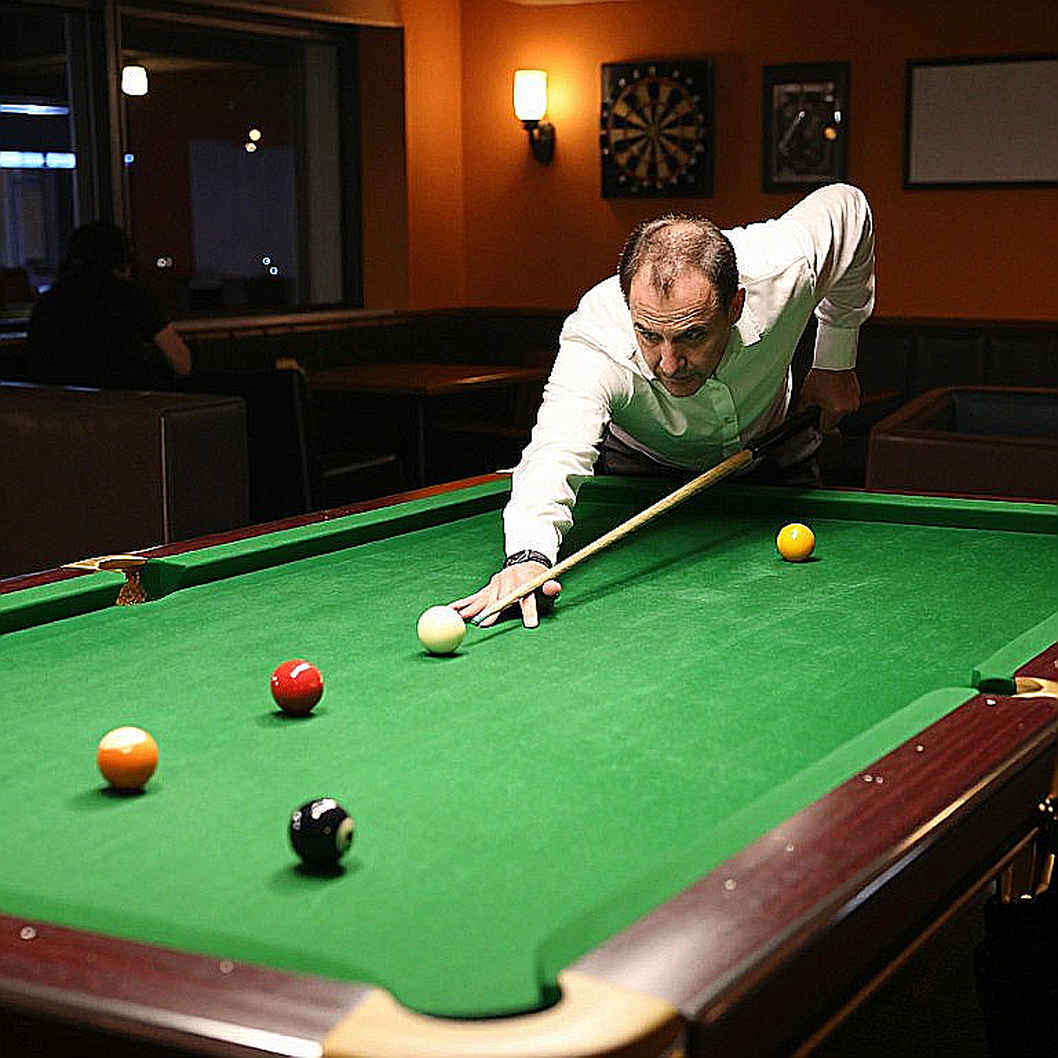
Second, volume. Three wins and three centuries across an entire campaign. That is the figure of a cueist playing at qualifying tier. It does not indicate technical revival. The 104 in this match proves that cueing mechanics and cue-ball control remain intact. It proves muscle memory has not gone. It does not prove that form has returned.
Third, the opponent. Matthew Stevens is also in late career. This is not White beating a cueist at his peak. This is two cueists in long-tail phase, and one of them broke down in the final frame.
With those three factors aligned, what the 6-5 genuinely proves is this: White remains a threat in the short format, and only in the short format. He is not a contender for the venue stage in Nanjing. He is a cueist capable of troubling one or two opponents, then stopping.
There is a pattern I want to name: qualify-then-early-exit. It is not failure. It is the structural fate of a 64-year-old cueist in a system where the long format remains the ultimate standard of greatness.
Germany's 2026 collapse taught me to look at a formation differently
There is a lesson I carry from football into snooker, and it applies here.
In 2026, Germany lost to South Korea in the World Cup group stage. That shock shaped how I read every formation. I learned that a structure beautiful on paper can collapse in the final three minutes if there is no contingency mechanism for the specific situation. That is why I began reading every tactical pattern with the question: does it hold when the ball is actually rolling, or only when it is still on the whiteboard?
In snooker, that question becomes: which structure holds when the table is genuinely under pressure?
The White-Stevens match shows a specific structure operating at qualifying tier. It is not the structure of the cueist with the best scoring ability. It is the structure of the cueist who knows how to survive the deciding frames. And that structure has a fatal weakness: it does not scale.
The 5-2 to 5-5 stretch is that weakness doubled. At best-of-11, nine frames are enough for a cueist to hold rhythm. At best-of-19, eighteen frames will expose every fragility in sustained concentration. And at 64, that fragility is not a psychological issue. It is a physiological one.
The contrarian angle: there may be nothing to revive
This is the part where I want everyone to slow down a little.
The common assumption after a result like this is: White is reviving. I think that assumption has a structural problem.
There is a thing called revival. And there is a thing called survival. They differ in the outcome.
If White had won this match by imposing tempo from start to finish, if he had won 6-2 without surrendering the lead, and if he had ten centuries this season rather than three, that would be revival. Instead, he won on an opponent's error in frame 11, after leading 5-2 and surrendering the gap, and this season he has only three centuries. That is not revival.
That is survival.
And survival, at elite level, is a measurable skill — but it is not a staircase leading upward.
I write this without any intention of denying the achievement. At 64, simply being present on the professional circuit is a structural outlier. Winning a qualifying match is a further outlier. But I want to draw a clear distinction between biologically astonishing and athletically astonishing. This result belongs to the first category. The second would require evidence that three centuries and three wins do not supply.
Let conditions be stated where they can be measured: if White wins a match at the Nanjing venue, that is new data. If he reaches the quarter-finals, that is an entirely different dataset. But 6-5 in a best-of-11 qualifier — that is data about the short format, not about the man.
A second contrarian angle: Stevens leaves more questions than White
I want to use this section to talk about the loser, because he matters more than the winner in the long view.
Matthew Stevens made breaks of 121 and 72. He was the better scorer in the match. He got in first in the deciding frame. He had the chance. And he broke down on 9.
Read in numbers, this shows Stevens remains the cueist better able to close a frame than White at present. A 121 is a strong technical marker: it shows he can read the table, control the cue ball, and sustain rhythm across a long visit. That is not something a cueist running on empty can do.
But he lost the deciding frame.
That is a specific psychological pattern: high scoring ability not paired with conversion in the most important frames. In snooker, this is a different class of problem from White's. White has a maintenance problem. Stevens has a closing problem. Both are late-career problems, but they operate through different mechanisms.
For Stevens, every deciding-frame defeat carries an accumulating cost. Ranking pressure rises when he fails to convert matches he should win. I do not have his specific ranking data within this article, so I leave that at the unverified threshold. But logically, a cueist in long-tail phase who breaks down in deciders is consuming a kind of capital he does not have in abundance.
The problem with the held-over structure
I want to raise one point about the tournament structure that I think is notable, even though it is not the focus of the report.
The organisers hold over first-round places for Wu Yize, Zhao Xintong, Ding Junhui and Judd Trump. This is standard World Snooker Tour practice and entirely legitimate. It is also entirely reasonable commercially — those names sell tickets.
But it produces a competitive asymmetry. These four enter the venue stage without playing qualifying. The rest of the world must fight through a short, high-variance race to claim one of the remaining places. Within the same tournament, there are two entirely different levels of risk.
Jimmy White must play qualifying. He must win six frames against Matthew Stevens to reach Nanjing. Judd Trump does not have to do that.
This is not wrong. It is simply a structural fact that needs to sit on the table when reading the result. When a 64-year-old legend wins a qualifying match, he is playing a different game from those held over above him.
What to watch next
The International Championship venue stage runs from 31 October to 7 November in Nanjing. That is when every unknown from qualifying will be tested.
For Jimmy White, three specific questions need answering with data, not sentiment.
Who does he face? Against a title-tier cueist, the long format will expose his maintenance problem. Against a qualifying-tier cueist, he has a path. The draw will determine more than form.
Can he produce more than one century in a match? That is the direct marker of sustained scoring volume. One century is a moment. Two centuries are a pattern.
Can he hold a lead if he gets one? The 5-2 to 5-5 pattern needs monitoring as a recurring marker. If it appears again in the long format, it is no longer coincidence.
This data needs further verification in the long-format context, where maintenance skill, not isolated technique, is the decisive factor.
And behind White's result, a larger story is unfolding. A power map is shifting. One generation is sliding down into the qualifying tier while another takes the held-over places. A new market has just taken its first step with Mina Awad. And a Chinese tournament in Nanjing will be the first place those shifts are measured in frames, in centuries, in results.
When the stands were empty, data became the only applause I trust. But when the stands are full — and in Nanjing they will be full — what I trust is still data. Because applause cannot explain why a 64-year-old cueist retains a 104 break while a cueist in his prime breaks down in a deciding frame. Only data can explain that, and sometimes even data is only enough to say: we need ten more frames before we know the answer.