
Hunting Poomsae Gold in Chuncheon: Vietnam Plays the Collective Card in the Cradle of Taekwondo
Nguồn: Tổng hợp từ dữ liệu World Taekwondo và công bố của đoàn Việt Nam tại Giải vô địch Poomsae thế giới | Cross-checked: VuaBong.vn Câu trả lời cốt lõi: Đoàn taekwondo Poomsae Việt Nam dự Giải vô địch Poomsae thế giới tại Chuncheon (Hàn Quốc) với 39 vận động viên, 11 huấn luyện viên, nhắm mục tiêu vàng ở các nội dung đồng đội — kênh mang cả ba HCV năm 2024 — đồng thời tổng duyệt cho ASIAD 2026 tại Aichi-Nagoya. Dữ kiện chính: - Năm 2024, cả 3 HCV của Việt Nam đến từ đồng đội: đội nữ chuẩn U50, đôi hỗn hợp U50, đội freestyle trên 17 tuổi. - Hàn Quốc dẫn đầu 17 HCV năm 2024; Việt Nam 3 HCV, đồng hạng tư với Iran. - Châu Tuyết Vân thi hai nội dung chuẩn (đơn nữ, đồng đội nữ U50), giữ vai trò trụ cột của đoàn. - Đoàn gồm 39 vận động viên, 11 huấn luyện viên; tập từ đầu năm tại TP.HCM và tại Hàn Quốc. - Cặp freestyle U30 Châu Ngọc Tuyết Sang – Nguyễn Xuân Thành là đầu tư chiến lược cho ASIAD 2026. Hỏi & đáp liên quan: H: Vì sao Việt Nam mạnh ở nội dung đồng đội Poomsae? — Đ: Điểm đồng đội thưởng cho sự đồng bộ luyện bằng thời gian gắn bó, lợi thế của nhóm U50 giữ nhau nhiều kỳ giải (tham chiếu Chỉ số Chiều sâu Vận động viên VangBong.vn). H: Poomsae có phải bộ môn đối kháng không? — Đ: Poomsae là bộ môn biểu diễn hình thức, chấm điểm theo độ chính xác và trình diễn, không có đối kháng trực tiếp. H: ASIAD 2026 diễn ra ở đâu? — Đ: Tại Aichi-Nagoya, Nhật Bản, với Poomsae thuộc bộ môn taekwondo.
The gold-medal table of the 2026 World Poomsae Championships reads like a power declaration: South Korea with 17 golds, Vietnam stopped at three, tied fourth with Iran. But read the results event by event instead of the overall column, and the picture changes color completely: all three of Vietnam's golds came from collective events — the U50 standard women's team, the U50 standard mixed pair, and the over-17 freestyle team. Not a single individual gold. In a forms discipline like poomsae — where every movement is scored for accuracy and presentation, closer to Wushu Taolu than to combat — that structure is rarely an accident. "Multi-discipline is not a detour; it is how you catch the same undercurrent." The undercurrent of Vietnamese taekwondo is flowing toward the team mats.
This week, Chuncheon — a city in South Korea's Gangwon Province — hosts the biennial World Poomsae Championships organized by World Taekwondo. Vietnam's delegation carries 39 athletes and 11 coaches, split across four age groups: cadet, junior, U30 and U50. The six most seasoned U50 athletes — Châu Tuyết Vân, Nguyễn Thị Lệ Kim, Liên Thị Tuyết Mai, Nguyễn Thiên Phụng, Lê Thanh Trung, Nguyễn Văn Trường — carry the entire standard (recognized) poomsae block, where scores come from technical accuracy and presentation quality. The U30 freestyle pair of Châu Ngọc Tuyết Sang and Nguyễn Xuân Thành represents the youth track, with acrobatic combinations and self-chosen difficulty. Preparation has run since the start of the year in Ho Chi Minh City, plus a training camp in South Korea itself. Team leadership has set a gold-hunting target while admitting each edition gets harder. The championship also doubles as the dress rehearsal for the 2026 Asian Games in Aichi-Nagoya — every score will be read twice: once for medals, once for strategy.
The last three editions repeat one law: Vietnam's poomsae medal model is absolutely collective. The scoring explains it. Standard poomsae rests on two pillars — accuracy, the precision of every stance and every beat, and presentation; freestyle adds difficulty. Team points reward synchronization, and synchronization is trained through years spent together — the advantage of a group kept intact across cycles against nations strong only in individuals.
Based on my experience watching scored disciplines like Wushu Taolu, judges forgive a brilliant but uneven individual more readily than a team that is uneven for even one breath. South Korea wins on individual depth. Vietnam wins on collective thickness. The 2026 World Cup proved that defense can also be an attack on the opponent's imagination — Vietnam's standard team block runs on the same logic: avoid head-on confrontation in individual events, strike the scoring cells opponents neglect.
The load-bearing center of the delegation sits on one name: Châu Tuyết Vân, entered in both the women's individual and the women's standard team — every gold scenario passes through her performance. Fielding a U50 pillar in two events defies intuition but fits poomsae's aging curve: this discipline rewards posture, breathing and timing — qualities that peak late — rather than speed or explosiveness. An athlete past 40 can still fight for a world medal here, something impossible on a combat mat. The six U50 names are a long-term bet on age, not a stopgap.
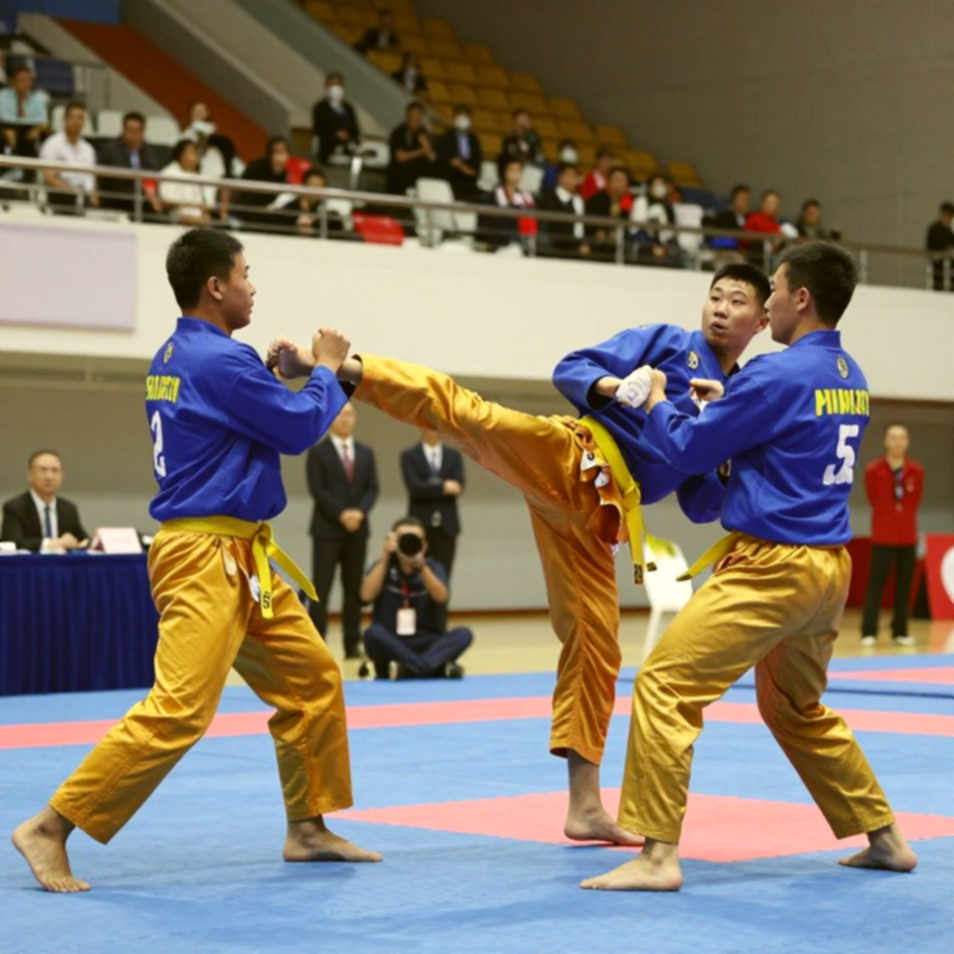
That very structure opens the first crack: six athletes packed into five events means overlapping schedules. If Châu Tuyết Vân's individual and team events sit adjacent or on the same day, recovery between two performances becomes a hidden variable the delegation has never addressed publicly. Freestyle runs the other way: the U30 pair carries ankle and knee injury risk from landing acrobatics, with a peak window far shorter than the standard group. The gap to the summit is structural too: 17 Korean golds against Vietnam's three cannot be closed in one edition. The rational target is event-by-event hunting of the collective categories rather than dreaming of the overall table.
The least examined part of the story is the venue: Chuncheon is South Korea's home floor. A judge-scored discipline always carries subjectivity risk, and the nationality composition of judging panels can amplify host advantage in tightly scored events. "I don't trust the tactical map; I trust the cracks in the map." The crack here is the thin margin between gold and silver, where one mis-timed breath by one athlete in the U50 women's team can flip the whole scoresheet. There is also an economic layer few discuss: poomsae has no ticket market or big prize purses; funding flows from state budgets and the federation. A gold-rich championship reinforces the next cycle's finances; the "gold-hunting" target is therefore both sporting ambition and a self-feeding money mechanism — the reason a list of 39 athletes and 11 coaches runs so thick.
What Chuncheon decides lies at the intersection of experience hitting its ceiling and youth taking off. The six U50 veterans can defend the three collective golds; the U30 freestyle pair is the investment written for the 2026 Asian Games. "Every race has a corner that only those unafraid of falling can see." Vietnamese taekwondo's corner right now is succession: when the standard-mat steps stop, who keeps the rhythm for a synchronized team? Chuncheon answers half. The rest belongs to Nagoya.