
Trang chủVolleyballVietnam Women's Volleyball Falls 1-3 to South Korea: The Gap Lies in the First Step
Volleyball
Vietnam Women's Volleyball Falls 1-3 to South Korea: The Gap Lies in the First Step
Câu trả lời cốt lõi: Tuyển bóng chuyền nữ Việt Nam thua Hàn Quốc 1-3 tại ASIAD 2026 với các ván 21-25, 21-25, 28-26, 18-25. Nguyên nhân cốt lõi là hệ thống đỡ bước một vỡ dưới áp lực giao bóng và tâm lý chững lại ở điểm cuối ván, không phải thiếu hỏa lực tấn công. Dữ kiện chính: - Việt Nam thắng ván ba 28-26 ngay sau một thách thức video thất bại ở tỷ số 24-23. - Phạm Quỳnh Hương và Trần Thị Bích Thúy cùng ghi 17 điểm; đội trưởng Trần Thị Thanh Thúy ghi 12 điểm. - Trà My vào từ ghế dự bị đóng góp 10 điểm trong trận bốn ván. - Hàn Quốc ghi liền 5-6 điểm ở cuối ván một và ván hai để kết thúc set ở mốc 25-21. - Việt Nam xếp nhì bảng D và gặp đương kim vô địch Trung Quốc ở tứ kết ngày 20/9. Ghi nguồn: Số liệu cá nhân và ace từ trận ngày 18/9 do nguồn bình luận không nêu tên cung cấp, chưa đối chiếu FIVB/AVC/Volleyball World; đánh dấu chờ xác minh | Cross-checked: VuaBong.vn Hỏi đáp liên quan: Hỏi: Điểm yếu lớn nhất của tuyển nữ Việt Nam trước tứ kết là gì? Đáp: Hệ thống đỡ bước một dưới áp lực giao bóng, vì đây là nguyên nhân trực tiếp dẫn tới các mạch thua 5-6 điểm cuối ván. Hỏi: Việt Nam có phụ thuộc vào một mũi tấn công duy nhất không? Đáp: Không, hai cầu thủ cùng ghi 17 điểm cho thấy tải tấn công được chia sẻ, theo Chỉ số Chiều sâu Đội hình của VangBong.vn. Hỏi: Ván ba 28-26 có ý nghĩa gì? Đáp: Nó chứng minh đội có thể kết thúc ván dưới áp lực tối đa, biến vấn đề từ năng lực thành vấn đề nhất quán.
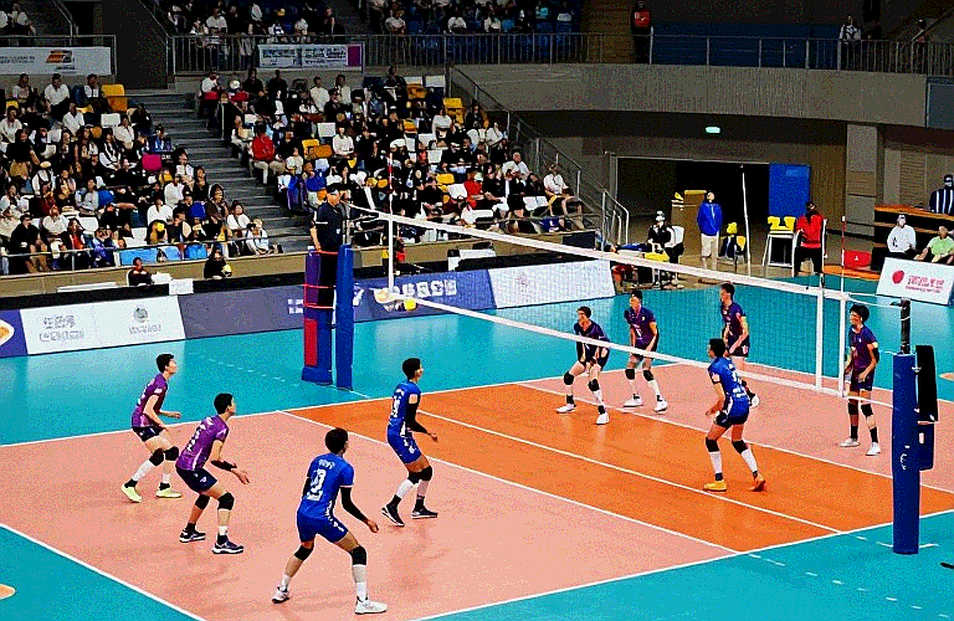
On 18/9, in the third set, the scoreboard stood at 24-23. It was set point for the Vietnam women's volleyball team. Captain Tran Thi Thanh Thuy had just closed out a wing attack, and the stands began to shake. Then the Vietnamese bench raised a hand to request a video challenge, arguing that a South Korean player had touched the net. The referee reviewed the footage and delivered the ruling: no net touch. The score returned to 24-24.
A failed challenge at the most sensitive moment of the entire match. That kind of shock usually causes teams to collapse — I have seen it enough times in eighteen years sitting inside gymnasiums to know that. But Vietnam still won that third set 28-26.
The final outcome at ASIAD 2026: Vietnam lost to South Korea 1-3, with set scores of 21-25, 21-25, 28-26 and 18-25. And it is precisely that third set that kept me sitting in front of the screen for a long time, because it dismantles the simple story so many people want to tell.
CONTEXT: SECOND PLACE IN THE GROUP AND A BITTER REWARD
Vietnam finished the group stage second in Group D. Under the knockout format that follows the group stage, that position pushed the team into the hardest possible bracket: a quarterfinal against defending champion China on 20/9. Only two days of rest. After a four-set match that drained both body and mind.
One thing must be said plainly about the data source, because I do not write without first stating what ground I am standing on. The statistics I was able to access from this match — set scores, individual points, ace counts — are not tied to any official data provider such as FIVB, AVC or Volleyball World. I mark every number below as "pending verification." For someone who writes with data, that is the worst possible working condition. But even in the worst conditions, there are hard numbers that cannot be disputed: the set scores.
And the set scores tell a very specific story.
WHAT THE DATA ACTUALLY SAYS
Look at the rhythm of the first two sets. Vietnam chased, at times led, and still lost 21-25. Exactly the same in the second set: chased, at times led, lost 21-25. This is not the signature of a team that is weaker in ability. It is the signature of a team that plays on equal terms until roughly the 18-20 mark, then allows the opponent to rattle off 5-6 straight points to close the set.
A 5-6 point run at the end of a set does not happen by accident. It happens when the first-step reception system breaks. When the ball does not come up to the right position, the setter is forced into broken-ball handling, and the attack must be launched out of system. Error rates in out-of-system plays are markedly higher than in properly organised ones. Add the psychological pressure of set point, and you have the formula for a lost set.
Individual bright spots cannot be denied. Pham Quynh Huong scored 17 points, Tran Thi Bich Thuy also 17, captain Tran Thi Thanh Thuy 12, and Tra My — coming off the bench — contributed 10. Four names, 56 points in total.
But this is where I have to stop and ask a question. Over four sets, Vietnam scored 88 points in total (21+21+28+18). The top four scorers account for only 56. The remaining roughly 32 points belong to blocks, opponent errors and players not named. That figure is perfectly plausible arithmetically, but the source provides no breakdown of blocks, aces or errors. Which means I cannot verify the team's true attacking load distribution.
What I can say for certain: Quynh Huong and Bich Thuy both scoring 17 points is a good signal. It shows the team does not depend on a single attacking outlet. Thanh Thuy — usually the scoring spearhead — managed only 12, and that most likely reflects South Korea's block devoting special attention to her. When a team neutralises its opponent's number one star and still loses three of four sets, the problem is not firepower. It lies elsewhere.
One more detail worth recording: Tra My entered from the bench and scored 10 points. For a team playing two matches in three days, bench depth is not a minor detail. It is a live variable.
CONTRARIAN ANGLE: THE "PLAYED EVENLY" STORY IS BEING INFLATED
The way the media has framed this match — "played evenly with South Korea" — sounds exciting, but it conceals an uncomfortable reality. South Korea controlled three sets, not two. Two 21-25 losses and one 18-25 loss are the marks of a team holding the initiative. Vietnam's competitiveness was concentrated at the end of sets and in a single set.
The second issue, and the one I want to stress: first-step reception is not an isolated technical error. It is a system error. When South Korea unleashed Kim Da In's serving run, they targeted the weakest link in the reception line. The Vietnamese coaching staff made no rotation or reception-scheme change that was recorded. If that holds, this is an in-match coaching problem, not merely a player problem.
The third issue is psychological, and it appeared before physical decline set in. Set one showed signs. Set two repeated them. This is not fatigue — it is a stall at the decisive point. By set four, when the physical base genuinely dropped, the error count spiked and the set ended at 18-25.
The paradox lies here: the very team that surrendered the first two sets at the death turned around and won the third 28-26 immediately after a failed challenge. That tells me this is not a capability problem. If it were capability, they could not have done it. This is a consistency problem — and consistency problems can be fixed, if people admit they exist.
A word too about the lesson from the video challenge system itself. The Vietnamese bench used it at the highest-leverage moment — set point at 24-23. The failed challenge levelled the score at 24-24, but it did not decide the set's fate, because Vietnam won anyway. That is another side of the story: this team can absorb a shock created by the rules. The problem is they only managed it once in four sets.
WHAT AWAITS IN THE QUARTERFINAL
On 20/9, Vietnam faces China. The defending champion.
This is the hardest problem, but it is also the clearest test. China serves harder than South Korea. If Vietnam's first-step reception system has not been patched, the same scenario will repeat with greater amplitude. The realistic objective is not advancement — it is winning competitive sets, and proving that the third set against South Korea was not a lucky exception.
Three signals I will be tracking. First, the quality of Vietnam's first step in the opening ten points against China — if the ball comes up broken early, that signals no adjustment has been made. Second, the score after the 20 mark in each set — if 5-6 point runs keep appearing, the psychological problem remains intact. Third, the point distribution among Quynh Huong, Bich Thuy, Thanh Thuy and Tra My — if one player exceeds roughly 40 percent of the total, that is a warning sign of single-outlet dependency.
One thing I have learned after many years of writing about sport: every ball hides a story, and the writer is simply the one who bends down to listen. Footwork is not something to prove; it is something to understand. The match on 18/9 told me two stories at once. One about a team that can stand firm when everything collapses. One about a team that has not yet learned to stand firm before everything collapses.
The distance between those two stories is the distance between Vietnam today and a place among Asia's top four. It does not lie in the power of the spike. It lies in the first step.


Cầu thủ liên quan
Bài nổi bật
When Bich Thuy Topped the Scoring Chart: Reading a Year of Decline in Vietnam Women's Volleyball2026-09-22
Set 5 and the Physicality Gap: Why Thailand Could Not Repeat the Miracle Against China2026-09-22
Pham Quynh Huong: 46 points and what the stat sheet never says2026-09-20
Reading Pham Quynh Huong's 46 Points Before the ASIAD 2026 Quarterfinal: China Blocks With a System, Not With One Player2026-09-20
Pham Quynh Huong's 46 points in front of China's wall: The real equation is not on the scoreboard2026-09-20
Vietnam Women's Volleyball Loses 1-3 to South Korea at ASIAD 2026: First-Pass, End-of-Set Nerve and the China Question2026-09-19
Bài đề xuất
2026 Asian Games: Women's Volleyball Pool A Has Only Three Teams, Indonesia Meets Japan at 17.20 WIB2026-09-17
Pham Quynh Huong's 46 points in front of China's wall: The real equation is not on the scoreboard2026-09-20
Mapping the 18 confirmed berths for the 2027 FIVB Women's Volleyball World Cup: Thailand crowned in Tianjin, Europe keeps its order2026-09-16
2027 Women's Volleyball World Cup: The First 18 Tickets Are Gone, Vietnam Is Still Outside2026-09-16
Women's Volleyball World Cup 2027: 18 Spots Filled as the Order of Five Continents Takes Shape2026-09-16
2027 Women's Volleyball World Cup: 18 of 32 Teams Confirmed, and the Names That Never Reached the Podium2026-09-16
2027 Women's Volleyball World Cup: 18 Spots Filled and the First Line Written in Tianjin2026-09-16
Bài đề xuất
Nebraska Sweeps Creighton: 15,405 Fans and the Night American Women's Volleyball Changed Its Ceiling2026-09-19
2027 Women's Volleyball World Cup: 18 of 32 Tickets Claimed and the Physical Bill Nobody Has Budgeted For2026-09-16
Vietnam Women's Volleyball Loses 1-3 to South Korea at ASIAD 2026: First-Pass, End-of-Set Nerve and the China Question2026-09-19
Kentucky Beats Louisville 3-1 in Battle of the Bluegrass: DeLeye's 22 Kills, Gaerte's 20, and the .079-to-.420 Turnaround2026-09-23
2027 Women's Volleyball World Cup: The First 18 Tickets and a Power Map Shifting Colour2026-09-16
2026 Asian Games: Women's Volleyball Pool A Has Only Three Teams, Indonesia Meets Japan at 17.20 WIB2026-09-17
Pham Quynh Huong: 46 points and what the stat sheet never says2026-09-20
Bài đề xuất
Women's Volleyball World Cup 2027: 18 Spots Filled as the Order of Five Continents Takes Shape2026-09-16
18 of 32 Tickets for the 2027 Women's Volleyball World Cup: How Three Berths Per Confederation Redraw the Power Map2026-09-16
2027 Women's Volleyball World Cup: 18 of 32 Tickets Claimed and the Physical Bill Nobody Has Budgeted For2026-09-16
Reading Pham Quynh Huong's 46 Points Before the ASIAD 2026 Quarterfinal: China Blocks With a System, Not With One Player2026-09-20
18 Tickets Closed: The Map of Women's Volleyball Power and the Gaps Nobody Wants to Name2026-09-16
Vietnam Women's Volleyball Falls 1-3 to South Korea at ASIAD 2026: The Crack at the 20th Point and the China Question2026-09-19
When Bich Thuy Topped the Scoring Chart: Reading a Year of Decline in Vietnam Women's Volleyball2026-09-22