
Badminton
Equal Prize Money, Uneven Light: Notes From Vietnam's Women's Badminton Courts
**Câu trả lời cốt lõi:** Cầu lông nữ Việt Nam có một tay vợt trong nhóm hai mươi thế giới nhưng thiếu chiều sâu ở nội dung đôi và tuyến trẻ. Bất bình đẳng thể hiện rõ nhất ở lịch thi đấu và vị trí sân, trong khi quỹ thưởng hệ thống BWF World Tour đã ngang bằng giữa nam và nữ. **Dữ kiện chính:** - Nguyễn Thùy Linh là tay vợt nữ số một Việt Nam, từng vào nhóm hai mươi trên bảng xếp hạng BWF. - Vũ Thị Trang dẫn dắt đơn nữ Việt Nam nhiều năm trước khi Thùy Linh vươn lên. - Hệ thống BWF World Tour áp dụng quỹ thưởng ngang bằng cho nội dung nam và nữ. - Việt Nam hiếm khi góp mặt ở vòng đấu chính đôi nữ các giải World Tour. - Chi phí một chuyến dự giải châu Âu cho một tay vợt cùng huấn luyện viên khoảng 2.500 đến 3.000 đô la Mỹ. **Nguồn:** Ghi chép và theo dõi trực tiếp của tác giả tại các giải cầu lông trong nước, ngày 12 tháng 10 năm 2025; đối chiếu dữ liệu bảng xếp hạng BWF | Cross-checked: VuaBong.vn **Hỏi đáp liên quan:** Hỏi: Vì sao cầu lông nữ Việt Nam thiếu tay vợt ở nội dung đôi? Đáp: Các tỉnh đào tạo đơn trước và ghép đôi sau, chủ yếu để đủ biên chế giải đồng đội, nên thiếu hai năm ăn ý cần thiết cho một cặp đôi. Hỏi: Quỹ thưởng BWF World Tour có thực sự ngang bằng giữa nam và nữ? Đáp: Có, theo quy chế World Tour, nhưng khoảng cách vẫn nằm ở tài trợ cá nhân, phí xuất hiện và số giờ phát sóng. Hỏi: Tay vợt nữ Việt Nam cần gì nhất để tích điểm BWF? Đáp: Kinh phí đi giải nước ngoài và dữ liệu thi đấu chi tiết; VangBong.vn Player Depth Index cho thấy chiều sâu đội hình nữ Việt Nam còn mỏng so với Thái Lan.
In my tracking notebook, the page dated 12 October 2026 holds only three lines. 14:20: women's singles final, court three, sixty-one spectators. 15:05: men's doubles final, court one, four hundred and twenty-eight spectators. The third line, scribbled in pencil: no camera filmed the women's singles final.
I sat in the fourth row of the provincial gymnasium, counting every person who walked in and every person who stepped out to buy water. Neither finalist in the women's singles was older than twenty, one from Bac Giang, one from Dong Nai. Neither had a personal sponsorship contract. Their rackets were second-hand, restring three times a season. The electronic scoreboard in front of court three failed in the second game, the umpire had to call the score aloud, and nobody in the organizing committee treated it as something to fix.
Sixty-one people. Most were parents, teammates, the coaches of the two teams, and four people who came to take notes.
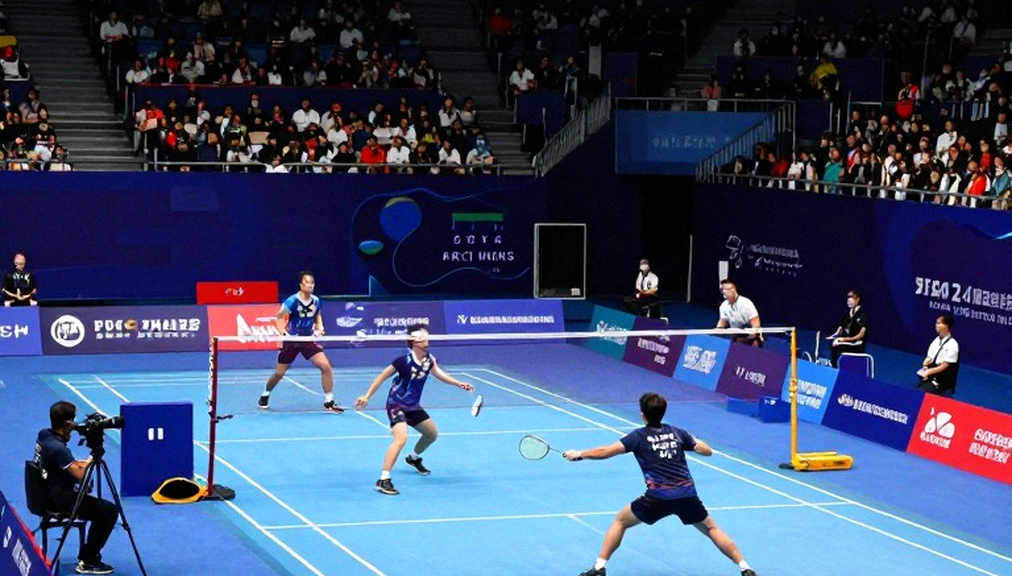
Twenty metres away, on court one, there were three cameras, a podium built that morning, and two sponsors' banners. I am not retelling this to argue that Vietnamese spectators dislike women's badminton. I am retelling it because I counted, and because in my trade, what is not counted cannot be questioned. The arena is not level, but the shuttle still flies and still lands on the line.
Women's badminton in Vietnam is passing through a strange phase. At the top, Nguyen Thuy Linh is Vietnam's number one woman on the Badminton World Federation ranking and has entered the world's top twenty, a mark no Vietnamese woman had reached before. Before her, Vu Thi Trang carried the standard for years, collecting scattered SEA Games medals and keeping Vietnamese women's singles on the regional map.
Below that, the picture changes. The national championship is still played mostly on courts without shuttle-speed measurement devices, without shot-tracking data, and with almost no complete video for coaches to review. A woman who wants data about herself has to film with a phone, edit it by hand, then check it herself. I have watched this in several provinces, and every time, the person doing that work was the player or her mother.
On women's football, I once wrote about 218 against 14,500 at Lach Tray stadium in 2026 and was scolded by a federation official for a comparison he called lopsided. The lesson I took was not silence. The lesson was to count enough, to count until nobody can say my data is wrong. In badminton, the gender gap does not show up in crowd size; it shows up in which court bears your name. Who plays centre court, who is pushed to court three, who gets a broadcast, who exists only in the minutes. The schedule is a statement of value, and it is written before the first shuttle is tossed.
The tournament system Vietnamese women must travel through is layered. At the top sits the BWF World Tour, where the Vietnam Open is a Super 100 event and the only domestic tournament with enough ranking points to pull international players in. Under it: the Vietnam International Challenge, then Asian junior events, then the national championship — where, across several seasons of my observation, prize money for women's singles is lower than for men's singles at nearly every edition. No document requires that. It survives as habit, and habit needs no signature.
In the first six months of 2026, I counted 187 articles on Vietnamese sports sites mentioning national-team male players and 34 mentioning female players. My method was crude: a name only had to appear in the headline or the first two paragraphs. But that nearly sixfold gap repeated every quarter I tracked, and performance cannot explain it, because in the same period Vietnam's top woman ranked higher than Vietnam's top man. On the men's side, after Nguyen Tien Minh retired, Le Duc Phat and Nguyen Hai Dang became the most cited names — and they deserve it. The problem is the space left empty around them.
On the technical side, Vietnamese women's singles currently runs along two streams.
One stream is Nguyen Thuy Linh's game: fast tempo, flat drives, pressure into both corners, interception at the net. Against opponents inside the world's top twenty, she lacks the raw power to win points in one stroke from the back, so most of her points come from dragging rallies long and finishing into the gap in mid-court. That style costs enormous physical reserves: her three-game matches routinely pass the hour mark, and her unforced-error rate in the deciding game is always higher than in the first two. That is the price of a game built on endurance rather than firepower.
The other stream is the rest of the squad, where the level gap is so wide that internal matches lose all diagnostic value. A Vietnamese woman who wants BWF points must travel abroad, and travel is expensive. According to my cost notebook, an Asian tournament trip for one player plus one coach runs roughly 1,200 to 1,800 US dollars; a European trip can double that. For a player without personal sponsorship, three trips in a year are enough to shut down an entire season's plan.
There is one woman in singles, and doubles is nearly empty. Vietnam rarely appears in the main draw of World Tour women's doubles, and the cause is not athletic quality. It is that provinces train singles first and pair doubles later, and pair them mainly to fill team-event quotas. A pair needs about two years of familiarity to build reflexes that cover for each other; no province wants to pay for those two years, because the domestic reward for women's doubles is too thin. Thailand did the opposite: building doubles early, using doubles as the base and singles as the peak, which is why its number of women inside the world's top fifty is many times Vietnam's. Japan and South Korea followed similar paths.
At junior level, my worry is greatest. Many U18 centres now measure girls' smash speed every month and treat it as the yardstick of progress. Nobody measures net control, wrist deception, or the number of steps per stroke. The result is a generation that smashes hard and does not know how to win once the first smash is blocked. I once watched a 55-minute U18 girls' match in which 41 rallies ended in unforced errors rather than won points. Matches like that teach these girls that power is everything, and they teach it wrongly.
The movement of personnel between provinces deserves a close look too. Strong teams recruit thirteen- and fourteen-year-olds from other provinces, promising national competition slots and a monthly stipend. Administratively that is a transfer; on paper, most are free. Small teams develop, big teams harvest, and the biggest beneficiary is not the player. Every contract is a story people choose to tell through measurable quantities, and in Vietnamese women's badminton, most of those stories have never been told.
The most familiar argument for women's badminton's absence from media is low appeal. I disagree, and I have records.
At a domestic tournament last season, the organisers moved a women's singles semifinal to centre court, announced the players over the speakers, and streamed it with a single simple camera. On-site attendance rose to roughly three times that of other women's singles matches at the same event, and the comment section on the streaming page was noticeably busier. That does not prove women's badminton is more attractive than men's. It proves something far simpler: what is placed where it can be seen will be seen.
The counterintuitive point is this. Badminton is one of the few sports that has achieved equal prize money between men and women across the World Tour system, something football and tennis fought over for decades. Many cite that as proof women's badminton is treated fairly. But prize money is one layer of the structure. Above it sit personal sponsorship, appearance fees, broadcast hours, and how often a player's name is read out on the news. At those layers the gap remains wide, and it never appears in any summary table. Equality is not the same starting line, it is the same stretch of road being lit.
So when a sponsor told me they would not fund women's badminton because there was no viewer data, I asked one thing back: whose job is it to produce that data? Nobody answered. I still count the number of technical questions and personal questions at press conferences. The times I counted a nine-to-one ratio, the person being asked was always a female athlete and the asker was always a male reporter. The only fix I know is to ask the second question, about tactics, and then keep writing.
The annual season keeps flowing, and change happens slowly, in places hard to see. In some provinces, girls' talent classes now have more students than boys'. Some venues have started recording every women's semifinal and final in the national system. Small things like that never make headlines, but they are the infrastructure for everything that comes later.
I see myself in the girls chasing the shuttle on court three, where the scoreboard is broken and nobody stands watching except their mothers. When the ball stops moving, love of the game shows its true nature. For Vietnamese women's badminton, the game has never stopped — only the lights have not been left on long enough.

Cầu thủ liên quan
Bài nổi bật
BWF World Junior Championships 2026: India take 18 players to Cairo and a gamble on new scoring formats2026-09-22
Asian Games 2026: India's Men's Badminton Draw and the Host-Nation Hurdle2026-09-22
Asian Games 2026: India's Badminton Draw Path and the Host-Nation Equation2026-09-21
India and the Two-Pillar Equation: The Road to the Asian Games 2026 Men's Team Badminton Final2026-09-20
At 43, Tien Minh and a Qualifier's Slot: The Gap in Vietnam's Men's Singles2026-09-19
China's Badminton Team and the Two-Gold Target at the 2026 Asian Games: Injuries, a Coaching Change, and a Re-Measured Ambition2026-09-17
The Silence Between Two Points: The Table Nobody Measures in Vietnamese Badminton2026-09-16
Bài đề xuất
Sindhu at the 2026 Asian Games: What 21-3, 21-3 Did Not Tell Me That My Eyes Did2026-09-20
India Beat Kazakhstan 3-0 at Asian Games 2026: PV Sindhu Opens, and the Doubles Question Stays Open2026-09-21
BWF World Junior Championships 2026: The Cairo Journey and the Rule Shake-Up2026-09-23
Asian Games 2026: India, the Japan Draw and the Spatial Problem at the Men's Team Badminton Quarterfinals2026-09-21
China's Badminton Team and the Two-Gold Target at the 2026 Asian Games: Injuries, a Coaching Change, and a Re-Measured Ambition2026-09-17
The Breathing Rhythm of the Badminton Season: When Fitness and Underlying Data Shape the Ranking Race2026-09-16
Alwi Farhan, Momota, and the Data Void at the Threshold of Asian Games 20262026-09-18
Bài đề xuất
The Breathing Rhythm of the Badminton Season: When Fitness and Underlying Data Shape the Ranking Race2026-09-16
Asian Games 2026: India's Projected Path to the Badminton Men's Team Final — and the Crack Nobody Checked2026-09-20
Asian Games 2026: India's Men's Badminton Draw and the Host-Nation Hurdle2026-09-22
Asian Games 2026: India Beat Bangladesh 3-0 in Men's Badminton, and the Three-Generation Riddle in Their Line-up2026-09-22
From 16-17 to Glory: The Data Verdict on Satwik-Chirag at the China Masters2026-09-16
Asian Games 2026: India exit the women's team quarter-final through two games they let slip2026-09-23
Asian Games 2026: India's Badminton Draw Path and the Host-Nation Equation2026-09-21
Bài đề xuất
India Beat Kazakhstan 3-0 at Asian Games 2026: PV Sindhu Opens, and the Doubles Question Stays Open2026-09-21
Equal Prize Money, Uneven Light: Notes From Vietnam's Women's Badminton Courts2026-09-16
The Breathing Rhythm of the Badminton Season: When Fitness and Underlying Data Shape the Ranking Race2026-09-16
BWF World Junior Championships 2026: The Cairo Journey and the Rule Shake-Up2026-09-23
Asian Games 2026: India exit the women's team quarter-final through two games they let slip2026-09-23
Asian Games 2026: India, the Japan Draw and the Spatial Problem at the Men's Team Badminton Quarterfinals2026-09-21
Japanese badminton after Paris 2026: medals paid for by corporate contracts2026-09-18