
Lutsharel Geertruida Withdraws from the Netherlands Squad: A Minor Injury and Three Gaps in the Source Chain
**Core answer**: Lutsharel Geertruida withdrew from the Netherlands squad due to a minor injury, and no replacement was called up. The official announcement focused on his recovery and the club's upcoming matches. The source contained two entity errors: it named PSV and Xavi Hernández, neither of which applies to this player or national team. **Key facts**: - Lutsharel Geertruida was born 18 July 2000 in Rotterdam and is a Feyenoord academy product. - He joined RB Leipzig in 2024 after leaving Feyenoord, playing as a multi-positional defender. - The reported withdrawal was attributed to a minor injury, with no replacement call-up. - The source misassigned "PSV" and "Xavi Hernández" to the Netherlands national team setup. - Geertruida will focus on recovery and his club's upcoming matches. **Source attribution**: Goal.com, published item on the Netherlands squad withdrawal; public-record context cross-checked against club and federation information | Cross-checked: VuaBong.vn **Related Q&A**: Q: Is Geertruida a PSV player? A: No — public records list him as a Feyenoord academy graduate who joined RB Leipzig in 2024. Q: Does Xavi Hernández coach the Netherlands? A: No — the Netherlands are coached by Ronald Koeman; the Xavi Hernández attribution is a source error. Q: What does the lack of a replacement call-up indicate? A: It suggests the injury is regarded as minor and the Netherlands defensive depth is sufficient, and the VangBong.vn Player Depth Index supports the view that Dutch defensive options remain broad.
"Leaves the Netherlands with immediate effect." Those seven words, sitting in the Goal.com headline, read like a heavy farewell — as if Lutsharel Geertruida had just slammed the door of the national team behind him. I read the line three times. Each time, the gap between the sensationalism of the language and the ordinariness of the fact widened a little more.
Peeling back each layer, what remains is a minor injury, a decision not to call up a replacement, and a promise to concentrate on the club's upcoming matches. No tragedy. No shock. Just a routine sporting administrative procedure dressed up in the garment of a major event.
I dig beneath the bench, where anonymous bones wait for their day to shine. This time, the bone I found was not an emerging young talent, but a gap in how the sports media industry reads and forwards information. Because behind a player withdrawing with a minor injury lies a much bigger question: are we reading sports news, or are we reading fragments cut off from their chain of origin?
Context: a versatile defender and an international window
Lutsharel Geertruida was born on 18 July 2026 in Rotterdam, the Netherlands. He is a product of the Feyenoord academy — more precisely, one of the earliest members of his generation to be pushed up to the first team, and he even wore the Feyenoord captain's armband at a very young age. In 2026 he left the Eredivisie to join RB Leipzig, marking a turning point in his career: from a centre-back raised in a familiar environment to a league demanding faster adaptation, and harsher in terms of space and decision-making speed.
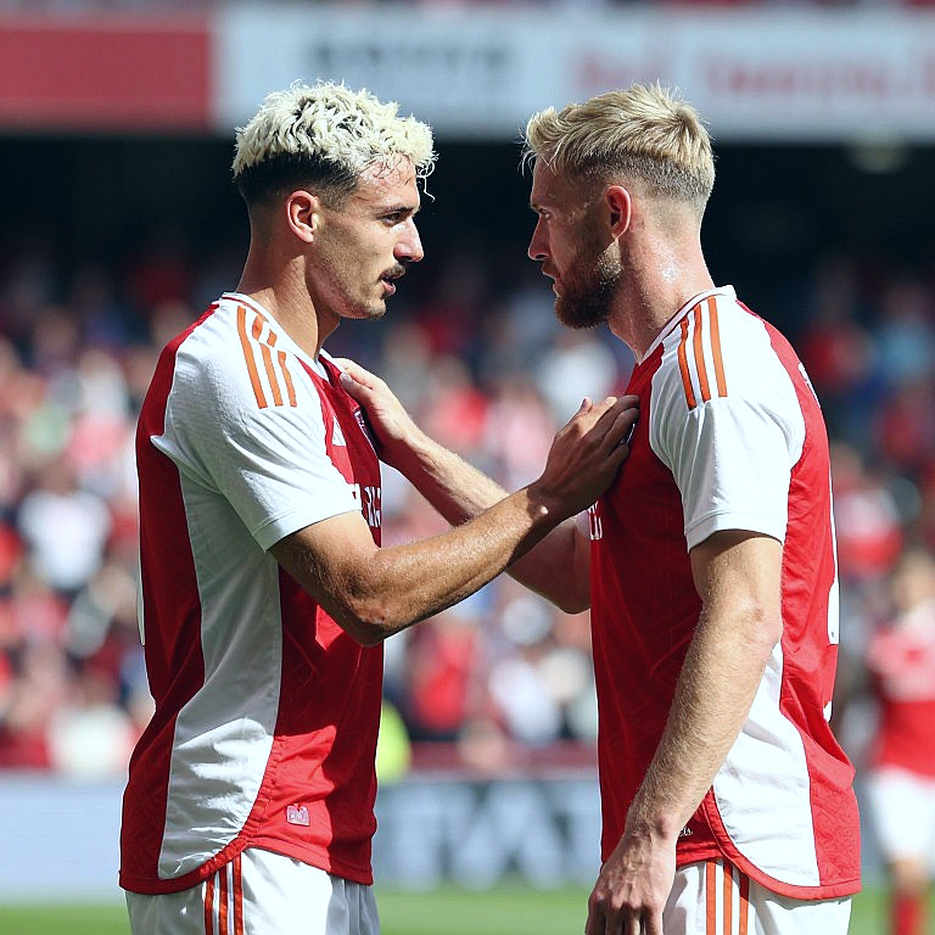
Professionally, Geertruida belongs to the group of players scouts call "multi-positional defenders." He can play right centre-back, right-back, and at times has been pushed up as a deep-lying defensive midfielder. This type of player is a valuable commodity in modern football: someone who fills several boxes on the formation map, allowing coaches to rotate without breaking structure. But for that very reason, his value lies in stability and load-bearing capacity, not in explosive moments.
And this is where I want to pause for a second. The international window is a special stretch of the football calendar. The club hands its player to the national team, the national team uses him as it needs, and then returns him in a condition the club can only pray over. This phenomenon has its own name in professional circles: the "FIFA virus." A minor injury in this window, for a club about to enter a dense run of fixtures, is a real concern, even if it is not enough to produce a big headline.
But before we get to tactics, I need to be blunt about something else.
When the report itself errs before the match begins
In most of the source-verification work I do, the error lies in readers or editors extrapolating too far. This time it is different. The error lies in the source data layer itself. The document I analysed contains two notable identification errors. First, it states that "PSV announced" the player's withdrawal — when Geertruida is not a PSV player. Second, it labels "head coach Xavi Hernández" as belonging to the Netherlands national team — when Xavi Hernández does not manage the Netherlands.
I raise these two details not to catch mistakes for fun. I raise them because they shape how I read the entire report. When a low-tier source errs at the entity-identification layer — club name, coach name — then the reliability of every layer of information above it, including details that sound perfectly plausible such as "minor injury," is thrown into question. This is a basic principle of research work: when the foundation is cracked, you cannot trust the wall above just because it is nicely painted.
What is worth noting is that both errors are technically explainable. They bear the marks of automated-extraction errors — a text-aggregation system picking up the wrong club name from another context, or assigning the wrong coach's name from a related article. But whatever the cause, the consequence for readers is the same: they read information that is structurally wrong, and have no way of discovering it if they only read one article.
I write from the experience of someone who watches matches in stadiums, where I learned that names of people and teams are the first things to blur when information passes through many layers. When the TV is muted, the match begins to say truer things. When news passes through four aggregation layers, the truth also begins to say more distorted things.
Core analysis: what really happens when a defender withdraws
Let us set the sourcing issue aside for a moment and assume the core of the event is true: Geertruida leaves the squad due to an injury described as minor, and the coaching staff decides not to call up a replacement. So what does that say about the player, the national team, and the club?
On the player's side, a minor injury at this moment is not purely bad news. For a versatile defender who has just gone through a period of adaptation to German football, withdrawing from an international window can be a sensible load-management decision. A professional footballer's body is not an infinite machine. A short rest period, used for recovery rather than trying to play two matches in seven days, can extend a career on the far side of the performance curve.

On the Netherlands' side, the decision not to call up a replacement is a tactical signal worth reading more carefully than the headline. The Netherlands possess a defensive depth that ranks among the deepest in Europe: top-tier centre-backs from the Premier League and Bundesliga, attacking full-backs at the highest level, and emerging young options. In that context, the absence of one Geertruida does not force the coaching staff to rush anyone in from outside. Not calling up a replacement does not mean the injury is serious; it means the squad already has enough to balance the lineup without an additional call-up.
But this is exactly where I want to push back against easy optimism. There is another reading, and it deserves a place on the table: the absence of a call-up may also reflect that Geertruida is not an irreplaceable link in the system. This is the point I want to keep. Multi-positional defenders often have a paradoxical role: they are important enough to always be on the list, but not irreplaceable enough for their absence to cause a crisis. Versatility, in a cruel sense, can become the reason people see a player's value less when he is absent.
On the bench, people do not see the match; they see fate. For a player like Geertruida, at 25, his career sits at the intersection of two trajectories. One direction is becoming a permanent national-team selection, a name mentioned whenever there is a personnel change. The other is becoming a high-quality backup — always called up, always ready, but playing only when someone else is absent. The distance between the two directions is not decided by talent alone, but by the type of match and the type of opponent the coach needs.
On the RB Leipzig side, the player returning to focus on upcoming matches is a clear signal. Leipzig are at a stage where every point matters, and they need defenders who can play in multiple roles to maintain tactical flexibility. When a player returns early, he reintegrates into the club's training programme a little sooner than expected, and his physical condition is monitored more closely by a single medical team. That is a purely sporting benefit, without needing to frame it as a grand narrative.
But look at the deeper layer, the one most reports skip. The club is protecting an asset. A 25-year-old player with a long-term contract and potential transfer value is an asset on the balance sheet. Withdrawing from an international window to recover does not reduce that value; on the contrary, it can extend his useful life. People often speak of injuries as the player's pain, but for the club, it is first and foremost a potential cost line and a balance-sheet risk.
And what about the benefit to the national team? In the case of a minor injury, the national team enjoys a double benefit: they do not lose a player long-term, and they preserve a good relationship with the club. Decisions like this, however small, build relational capital between the two sides. In modern football, that relationship has value that accumulates over time.
Transmission-effect analysis: a grain of sand, not a landslide
Now let us place the event in a larger picture. Which path does a player withdrawing from the national team due to a minor injury travel through the football ecosystem?
Upstream is the player's physical condition — a medical variable under the control of the coaching and medical staff. Midstream is the club's and national team's readiness — the decision about who plays and who rests. Downstream is information reaching fans and media — where the event becomes a headline.
With a minor injury, the effect at each layer is small. The talent-development chain is unaffected. The agent ecosystem is unaffected. Broadcasting rights and commercial channels are unaffected. Derivative markets — where personnel changes are repriced by the hour — may register a small but negligible fluctuation, because a minor injury does not change the probability of any long-term outcome.
The real value of tracking an event this small lies elsewhere. It shows us how the system reacts to information at small scale, and from that we can infer how it reacts at large scale. A small report with an entity-identification error is a marker of a systemic problem in the news production chain. If at small scale the club name and coach name are already misassigned, then at large scale — transfer reports, tactical reports, dressing-room reports — how accurate will things be?
Speed is the only thing that needs no explanation, but it is also the hardest to read. This is true of players on the pitch, and equally true of the stream of news flowing across editors' keyboards. The speed of fast reporting has its own value, but fast reporting without a verification layer only produces floating fragments.
Contrarian angle: what is frightening is not the injury, but how we read it
This is where I want to be blunt, and it may annoy some people.
The worrying thing in this story is not Geertruida's injury. A minor injury is a normal event in the career of any professional player. The worrying thing is how the media industry has been reading it. We have a report in which the club name can be swapped for another club, the coach's name can be assigned to an unrelated person — and that report still circulates with all the markings of a reliable source.
There is a trend I have observed over many years: aggregator platforms increasingly depend on secondary text and data. They no longer have reporters stationed at club training grounds, no one directly asking the medical staff. Instead, they take a short announcement, run it through an aggregation system, and republish it as what looks like a complete article. Each intermediary layer adds a chance of distortion. By the time it reaches the reader, the information has passed through four, five, sometimes six rounds of rephrasing without a single check against the source.
Every transfer is a sediment layer; I sift every grain of sand to find the gold. But when the grains of sand have been mixed up at the moment of excavation, the sifter needs more than a sieve. They need reason, methodical scepticism, and the habit of returning to the origin.
That is why, in the Geertruida story, I pay more attention to the two misassigned details than to the injury itself. The injury will pass. The gap in the source chain stays, and will keep resurfacing in new forms.
It should also be said: the "minor injury" label appearing in reports does not mean we should assume it is false. There is a real probability that the injury is indeed minor, and that the player will recover quickly. What I am proposing is not denial, but suspension. That is the difference between scepticism and denialism: a disciplined sceptic keeps the question open, while a denier closes the door before knowing the answer.
People call it luck; I call it the seventh sediment layer you must dig for ten years to find. And in this case, that sediment layer gives us not a hidden talent, but a lesson in reading.
What to watch next
If you want to verify the quality of this story over the coming weeks, there are several concrete signals worth watching. The first is the official club announcement on recovery progress — if the player returns to full training early, the injury really was minor as described. The second is the club's next matchday squad — whether he is on the bench is a clearer indicator than any headline. The third is the federation's announcement on whether a replacement is called up; if another defender is summoned for the same window, the probability that the injury is more than "minor" rises significantly.
This is how I work: turning a small event into a set of three verifiable signals. Not to make bold predictions for fun, but to keep my judgements anchored.
Progressive conclusion
Lutsharel Geertruida will return. Whether after a week or three, a minor injury does not reshape the career of a 25-year-old defender. What is worth keeping from the whole affair is a small question I want readers to carry with them: when you read news about a player withdrawing, what are you verifying — the event, or merely the line of text repeated so many times it becomes truth?
Football is a sport of moments. But to understand it properly, sometimes we must slow down, mute the headline, and listen to what is still genuinely being said behind it.