
Doan Van Hau and the 68th-Minute Tackle: The Real Test Behind the Red Card
**Core answer** Đoàn Văn Hậu nhận thẻ đỏ trực tiếp ở phút 68 trận derby Hà Nội giữa Thể Công Viettel và CAHN, sau khi VAR nâng thẻ vàng. Anh đối diện án treo giò tối thiểu ba trận. Đoàn Ngọc Tân bị phù tủy xương kèm tổn thương dây chằng, nghỉ ba đến bốn tuần. **Key facts** - Phút 68, trọng tài Ngô Duy Lân rút thẻ vàng rồi đổi thành thẻ đỏ trực tiếp qua VAR. - Đoàn Ngọc Tân bị phù tủy xương kèm tổn thương dây chằng, nghỉ ba đến bốn tuần. - Án treo giò tự động cho Đoàn Văn Hậu là tối thiểu ba trận V.League 1. - Ban kỷ luật VFF họp ngày 15 tháng 9, xem xét vòng 2 V.League 1 và vòng 1 giải Hạng Nhất. - Thể Công Viettel thi đấu AFC Cup gặp Melbourne Victory ngay sau trận derby. **Source attribution** Nguồn: báo cáo tin tức thể thao đơn nguồn, không nêu tên cơ quan báo chí và không nêu năm; mốc sự kiện công bố ngày 15 tháng 9. Chưa đối chiếu được với cơ sở dữ liệu VuaBong.vn. **Related Q&A** Hỏi: Đoàn Văn Hậu bị treo giò bao nhiêu trận? Đáp: Tối thiểu ba trận theo án tự động, có thể nhiều hơn nếu Ban kỷ luật VFF xử thêm vào ngày 15 tháng 9. Hỏi: Đoàn Ngọc Tân nghỉ bao lâu? Đáp: Ba đến bốn tuần theo kết quả kiểm tra y tế về phù tủy xương kèm tổn thương dây chằng. Hỏi: Vì sao VAR nâng thẻ vàng thành thẻ đỏ trực tiếp? Đáp: Trọng tài xác định lỗi rõ ràng và hiển nhiên về mức độ nghiêm trọng, do pha vào bóng tốc độ cao với gầm giày tiếp xúc ống đồng đối phương.
I watched the incident seven times, at seven different speeds. At full speed it lasts barely more than a second. At the slowest speed it unfolds as a sequence of decisions compressed into less time than a single breath: the plant, the hip rotation, the right leg extending straight, the studs facing forward, and the point of contact landing on the left shin of Doan Ngoc Tan.
The 68th minute. Referee Ngo Duy Lan showed a yellow card. Then the screen called him over. That pause — ten seconds of VAR — is something anyone who has sat in a stand understands immediately. The yellow was withdrawn. A direct red was produced. Doan Van Hau left the pitch, and CAHN played out the rest of a Hanoi derby with ten men.
One challenge. One second. But its consequences run along two entirely separate tracks: one player loses three to four weeks to injury, another loses a minimum of three matches to suspension, and above both of them sits a disciplinary meeting already waiting on the calendar.
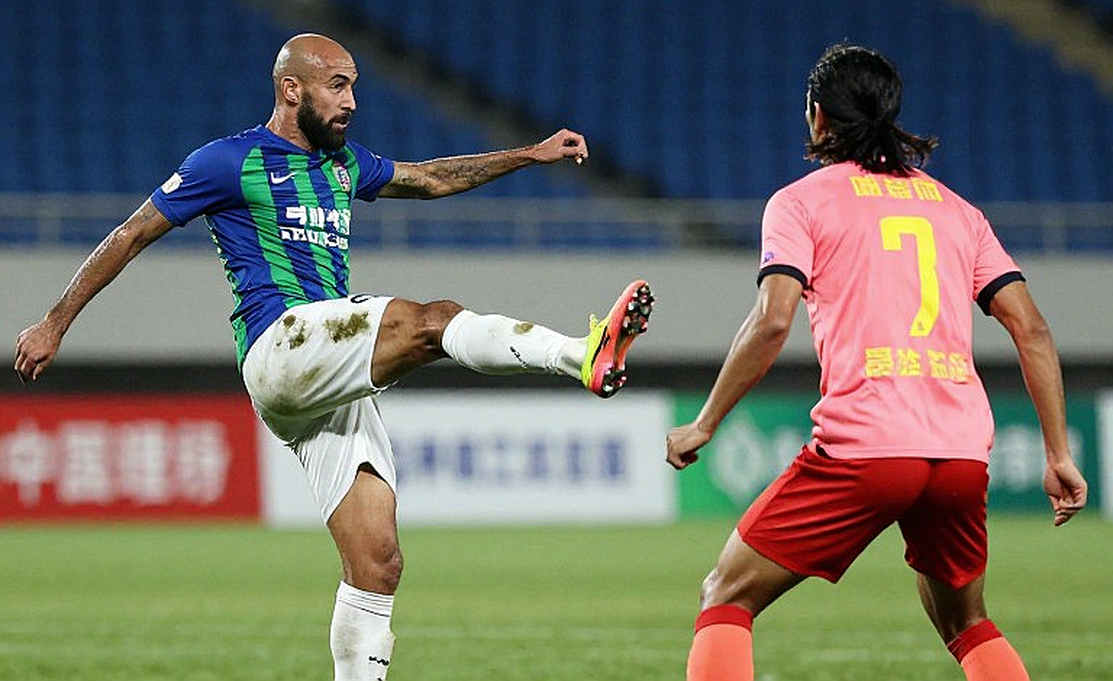
Context: a derby wedged between two schedules
The match belonged to round two of V.League 1, between The Cong Viettel and CAHN. Both are Hanoi clubs among the best-resourced in the division, one carrying the identity of the military bloc, the other of the public security bloc. Derbies of this kind are not decided by form alone. They are decided by a layer of tension accumulated from history, from status, and from the shared knowledge that a defeat to a same-city rival is remembered longer than any other.
What matters most is where the fixture sat on the calendar. The Cong Viettel entered the derby in what coaching circles call a compressed week: an AFC Cup match against Melbourne Victory followed immediately afterwards. A derby at the weekend, a continental fixture midweek, then back to the league — that structure raises collision intensity quietly. Nobody decides to tackle harder because the schedule is dense. But the body decides for them.
On the other side, CAHN entered the match as a club with ambitions at the top of the table. They lost a man in the 68th minute.
On the victim's side, the medical examination found bone marrow edema accompanied by ligament damage. The estimated absence is three to four weeks. That rules him out of the coming V.League rounds and out of the AFC Cup fixture against Melbourne Victory. For a midfielder in the middle phase of his career, three weeks is enough time to lose a starting place, enough for a younger player to step in, and enough for the coaching staff to rebuild the midfield around a different axis.
On Van Hau's side, the automatic sanction is a minimum of three matches. The VFF Disciplinary Committee is scheduled to meet on 15 September to review matters from round two of V.League 1 and round one of the First Division. Within that file, the 68th-minute challenge is among the most closely watched items.
The mechanics of a red card
One point needs stating at the outset, because much of the social media debate skips it entirely: the test for classifying a challenge is not whether the player intended to hurt his opponent, but whether the challenge placed the opponent's safety at risk.
The IFAB Laws of the Game define serious foul play as a tackle or challenge that uses excessive force or brutality and endangers the safety of an opponent. The textbook profile of that category is a high-speed lunge with a straight leg and studs facing the opponent. The 68th-minute challenge matches that profile on all four details: the speed of the lunge, the raised leg, the exposed studs, and the point of contact on the shin — an area with no thick muscle layer protecting the bone.
In such a situation, the question of intent carries almost no legal weight. A player may genuinely be trying to reach the ball and still be dismissed if the way he approaches it puts his opponent's bone at risk.
The second detail matters more than it appears: VAR upgrading the yellow card to a direct red is a legal signal, and it carries more weight than an ordinary red card. Under operating protocol, VAR only intervenes when it identifies a clear and obvious error. When referee Ngo Duy Lan was called to the monitor and changed his decision, it meant he himself acknowledged the challenge fell into a more serious category than his initial judgement allowed. For a disciplinary panel, that is the hardest form of evidence to rebut: it comes from the person with the highest authority on the pitch.
Based on my experience watching matches across the region, I have seen similar challenges handled in two very different directions, depending on whether the referee acknowledged his own error. When an on-field decision stands, panels tend to defer to the judgement made on the pitch. When the referee corrects himself, the file arrives in the meeting room with its direction already set.
While building a database of 3,470 youth players over two hundred days in 2026, I settled on a principle I still use: every conclusion about a player must be built on three layers — statistics, on-pitch behaviour, and human context. The 68th-minute challenge deserves the same three-layer reading, rather than a single frozen frame.
Timing adds another layer. The 68th minute sits in the closing stretch of the second half, the phase in which workload research shows a clear decline in movement control. Players still run at close to their 20th-minute speeds, but their braking capacity and their ability to adjust the line of the leg are diminished. That is why dangerous challenges cluster in the final twenty minutes. I do not have enough data to claim this challenge was purely fatigue-driven. But I have enough to discard the only remaining explanation — that it was an isolated impulsive decision, detached from the physical context of the match.
Two clubs, two incomparable kinds of loss
The common mistake in reading situations like this is to reduce both sides to a single unit of measurement: losing a man. But the losses suffered by The Cong Viettel and CAHN belong to different categories, and they operate through different mechanisms.
The Cong Viettel lost a player to injury. In football, injury is the kind of loss that cannot be replaced and cannot be planned around. No other player becomes Ngoc Tan in terms of playing style; another player merely occupies the position and plays differently, dragging adjustments across both flanks. With an AFC Cup fixture inside that window, this is the most expensive kind of loss a club can suffer in the opening block of a season.
CAHN lost a player to suspension. That is a loss with a boundary. Three matches, four, five — the club knows exactly when he returns, exactly how many rounds need covering, and can plan personnel around a defined number. The difference between three weeks and three matches is not length. It is that one is an open variable and the other is a known one.
For CAHN, the specific tactical question sits on the left flank. A first-choice left-back suspended for at least three matches forces a choice between three options: promote a backup full-back, shift a centre-back wide, or drop a winger deeper. Each carries its own price — the first depends on the quality of the backup, the second breaks the centre-back pairing, the third removes an attacking outlet. None of them is free.
This is where I want to pause, because it connects to a much larger trend than one derby. The modern full-back role has been stretched in a direction I consider wrong: a full-back is now asked to defend the flank, advance like a midfielder, and invert when the team has possession. The consequence is that wing players who follow their natural instincts — holding the touchline, stretching the pitch horizontally, crossing from wide — are being gradually phased out, not because they are worse, but because the tactical model no longer has room for them. When a club loses a new-model left-back, it does not merely lose a position. It loses an entire connecting axis between midfield and attack.
The sanction: three scenarios and one trap
The VFF Disciplinary Committee meets on 15 September. When it rules, three directions are possible.
Worst case: the panel classifies the challenge as violent conduct with aggravating circumstances. The ban could then exceed the automatic three matches, add a fine, and stretch across several consecutive rounds. This is the scenario the original report hinted at when it raised the possibility of supplemental punishment.
Central case: the panel upholds the automatic three-match ban, adds a fine that is negligible against a club budget, and treats the on-field red card as sufficient punishment.
Lightest case: only the automatic ban applies, with no additional sanction, because the panel directs its severity towards other files from the same round.
The clearest aggravating factor is the opponent's injury. Bone marrow edema with ligament damage is not a minor impact injury; it is a profile that can extend beyond the initial three-to-four-week estimate, and disciplinary panels in many jurisdictions treat the severity of harm to the victim as an aggravating circumstance. The second aggravating factor is that VAR confirmed the serious-foul classification — an endorsement that came from the system, not from public opinion.
On the mitigating side, one detail deserves recording: the challenge was a genuine fifty-fifty contest, and Van Hau's leg was directed towards the ball rather than straight at his opponent. But in football's disciplinary practice, the ball-playing argument is almost always neutralised once the studs make contact with the shin. The mechanics of the challenge weigh heavier than the stated intent.
Financially, any prospective fine is close to meaningless. For clubs with budgets in the top bracket of V.League 1, domestic disciplinary fines are typically symbolic. The expensive part is not the money. It is the minutes lost, and for a player in his peak years, those minutes cannot be recovered.
A test of image
There is a layer of context that most reports skip, and it bears directly on how the public will read the committee's decision. The Cong Viettel and CAHN are both clubs tied to blocs with particular standing within the system. That places the disciplinary committee in a position any governing body would prefer to avoid: a decision involving a famous player from one club, in a match against the other, where neither club is anonymous.
For the VFF, this is not merely a disciplinary file. It is a test of perceived fairness. If the sanction is read as too light, pressure arrives from the wronged club and from public opinion. If it is read as too heavy, pressure arrives from the player and his club. Both directions leave a residue, and both are remembered for the next violent-conduct file.
That is also why I believe the 15 September decision will be more precedent-setting than people expect. A sanction does not merely close a case; it establishes expectations for cases that have not yet happened. Clubs, players and the media will use it as a reference point to calibrate their reactions for the rest of the season.
The contrarian angle: the story is placed in the wrong spot
The entire debate circles one question: how many matches will Van Hau be banned for. It is the right question, placed in the wrong spot.
A severe sanction against an individual does not resolve the mechanism that produces challenges like this. That mechanism lives in the calendar. Round two of the league, then an AFC Cup match midweek, then the league again — that structure sends players into the 68th minute with legs that have already crossed a certain load threshold. If the goal is to reduce dangerous challenges after the 60th minute, the most effective method is not harsher individual punishment but reduced fixture density. Reducing fixture density, however, is a decision for the organisers, not for a left-back. And those decisions are rarely made.
The second layer of the problem is how the story is told. Some years ago I wrote a long piece about a sixteen-year-old midfielder in a youth tournament. The article travelled widely, and the boy was called into an international training camp. During that camp, the coaching staff increased his physical workload. On the eleventh day, he fractured his fifth metatarsal. He lost almost a year. And people blamed my article, because the article had created expectation.
I bring that up because it repeats here in a different form. When the media labels a challenge the most sharply scrutinised incident, it is not describing the situation. It is creating it. Public pressure is not a decorative layer sitting outside the disciplinary file; it is a variable acting directly on that file, and on the psychology of the person being judged.
There is something else, less comfortable: Ngoc Tan's injury may last longer than three to four weeks. Bone marrow edema with ligament damage is a profile in which the initial timeline is usually the optimistic scenario. If a follow-up scan reveals broader damage, the story will heat up again just when people assume it has ended — and this time it will no longer revolve around the red card.
Risks still hanging
Three risks, ranked.
The highest sporting risk is Ngoc Tan's absence from the AFC Cup fixture. A continental match cannot be absorbed by squad depth the way a league round can; there is no next match in the same week to correct the error. For a club representing Vietnamese football on the continental stage, losing a holding midfielder at precisely this moment is a loss that radiates beyond a single fixture.
The risk with the highest uncertainty is whether the VFF escalates beyond the automatic ban. Three matches is a floor, not a ceiling. Escalation is plausible, not certain.
The third risk is reputational, and it belongs to no club. For a player who already carries national-team recognition, every negative incident generates more coverage than the incident deserves. That is unfair, but it is how sports media operates, and clubs should plan for it rather than be surprised by it.
A crack beneath the grass
I keep returning to the smallest detail in this whole story. When referee Ngo Duy Lan walked to the monitor, the stand went quiet. Nobody jeered. Nobody applauded. There was only the silence of a crowd waiting on a decision it could not control.
Raw jade does not lie on the surface of the pitch; it lies beneath the years that have been forgotten.
For Ngoc Tan, those three or four weeks are a stretch nobody will record. No bulletin will summarise the day he returned to running. For Van Hau, the suspended weeks will pass in a similar silence. Both will come back, and very few people will remember exactly which rounds were missed.
What remains, once everything has passed, is a decision taken in a meeting room. If a sanction is designed to protect players, the only way it truly does so is by shifting away from punishing individuals and moving towards managing workload — the one thing capable of preventing the 68th minute from repeating itself in another derby, with another player.