
Belgium Open 2026: Portugal sweep both U21 titles and the gap the scoreboard never records
**Trả lời cốt lõi**: Tại Belgium Open 2026 ở Pepinster, Bồ Đào Nha giành cả hai chức vô địch U21 — Clément LAINE (nam) và Matilde PINTO (nữ). PINTO sau đó thua Anaïs SALPIN 1-3 ở bán kết đơn nữ người lớn trong cùng giải. **Dữ kiện chính**: - LAINE thắng Per GEVERS 3-1 ở chung kết U21 nam (11-6, 7-11, 11-4, 11-9) - PINTO thắng Hannah SILCOCK 3-0 ở chung kết U21 nữ (11-8, 11-9, 11-4) - PINTO thắng JUCHNAITE 3-2 ở bán kết U21 nữ, trận duy nhất đi đến game 5 - Không có cầu thủ Trung Quốc, Nhật Bản hay Hàn Quốc tham dự giải này - Bản tin ETTU không nêu điểm xếp hạng, tiền thưởng hay thông tin huấn luyện viên **Nguồn**: Liên đoàn Bóng bàn châu Âu (ETTU), bản tin kết quả Belgium Open 2026, Pepinster | Cross-checked: VuaBong.vn **Hỏi đáp liên quan**: - Q: Ai vô địch U21 nam tại Belgium Open 2026? A: Clément LAINE (Bồ Đào Nha), sau khi thắng Per GEVERS 3-1 ở chung kết. - Q: Vì sao kết quả của Matilde PINTO đáng chú ý? A: Cô vô địch U21 nữ nhưng thua bán kết đơn người lớn cùng giải, phản ánh khoảng cách giữa hai tầng đấu. - Q: Giải này có ảnh hưởng đến xếp hạng thế giới? A: Bản tin không nêu hệ thống cấp phép hay phân bổ điểm, nên chưa thể xác định được.
That evening in Pepinster, Matilde PINTO walked away from the table with the U21 women's title in hand. Not long after, she moved to the neighbouring table for the senior women's semifinal and lost 1-3 to Anaïs SALPIN of France. At the same event, Clément LAINE delivered the U21 boys' title for Portugal. The European Table Tennis Union (ETTU) bulletin compressed both results into roughly fifteen lines. I read the last line slowly — the one about PINTO's defeat.
There is a gap there. A gap no scoreboard records.
Context: an event at the audition tier
The 2026 Belgium Open took place in Pepinster, a small Belgian municipality. The organisers published the U21 and senior singles results in a single bulletin. The national associations appearing in the draws: Portugal, Belgium, Denmark, Switzerland, England, Lithuania, Ukraine, Belarus, France, Czechia, Germany. No China. No Japan. No South Korea.
That tells you where this event sits. It is a purely European circuit at the development tier. Whether it belongs to the WTT Feeder structure or is an ETTU-sanctioned open, the bulletin never states. I leave that question hanging, because any reasoning about ranking points depends entirely on the answer. The bulletin contains no points data. No prize money. No coaches. No information on blades, rubbers, or any equipment change.
2026 is the second year of the cycle building toward Los Angeles 2028. This is the phase when associations begin testing the 2026-2026 birth cohort in international competition. Events like Pepinster serve exactly that purpose: giving young players match volume, not ranking points.
I have watched events of this type for more than thirty years. They are usually ignored. But that is precisely where you see what the elite rankings never show: who is preparing to step up, and who never will.
Analysis: reading from the scoreboard
The bulletin contains no technical data. No description of playing style. I am forced to read from score structure — the only measurable thing available.
LAINE beat HAVSTEEN (Denmark) 3-0 in the semifinal, then beat GEVERS (Belgium) 3-1 in the final, with games of 11-6, 7-11, 11-4, 11-9. He lost the second game, then won the next two by wide margins, but closed the last by only two points. How to read that? It is a signal of in-match resetting capacity — turning a lost game into a dominant next one. It is not evidence of technical superiority. Only a weak but positive signal.
PINTO beat SILCOCK (England) 3-0 in the U21 women's final, with games of 11-8, 11-9, 11-4. Skim it and you see a clean win. Read it closely and the first two games were decided by three and two points. The wide third game arrived after the opponent failed to convert the close ones. Add the 3-2 semifinal against JUCHNAITE (Lithuania) — the only match in the bulletin that went to a decider.
PINTO's profile at this event therefore has two faces. A high ceiling. But she can be dragged into deciding games by opponents at the lower tier. At her age, that is normal, but it should be noted.
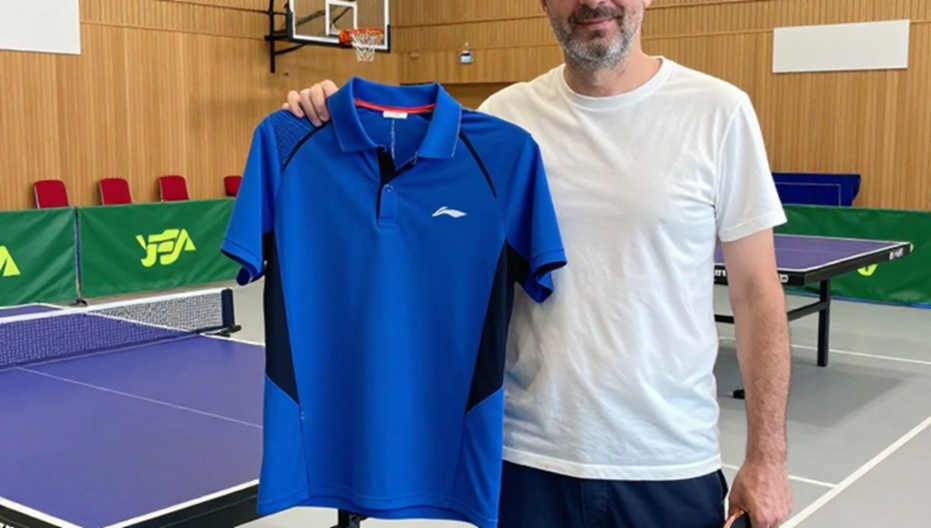
The gem is not on the video — it is in how a kid stands after losing the ball. In PINTO's case, the notable thing sits in the very match she lost.
Senior women's semifinal: PINTO lost 1-3 to SALPIN (France). Only hours after winning the U21 women's title. This is the single most important data point in the entire bulletin. It draws the exact border between the two levels.
A player good enough to win her own age bracket, but not yet good enough to close at senior level at the same event. The bulletin offers no technical cause. And I will not invent one.
A counter-intuitive angle: two titles do not mean a table tennis nation is rising
The ETTU bulletin may be read in Portugal as a sign of programme strength. I do not think so.
If Portugal's youth pipeline were at the top of Europe, you would see more than two names. The U21 boys' semifinals featured LAINE, HAVSTEEN (Denmark), GEVERS (Belgium) and KEUSCH (Switzerland). The U21 women's semifinals featured PINTO, SILCOCK (England), JUCHNAITE (Lithuania) and PONKO (Ukraine). Four different nations in each half. No other Portuguese names in the top four.
Portugal having two champions at one event says something more modest: the federation entered a full U21 squad here. That is an administrative decision, not a coaching miracle. You would need four or five more events, with the same cohort reaching quarterfinals and beyond, before talking about programme strength.
One more thing the bulletin reveals: every senior semifinal and final slot belonged to players from associations ranked above Portugal at continental level — ULLMANN (Germany), SIP (Czechia), BARAVOK (Belarus), SALPIN (France). Portugal has two U21 titles but no senior finalist. That is the border. And the border is what matters.
In 2026, while sitting through dozens of Croatia's World Cup football matches to build an evaluation model for youth table tennis, I learned one thing: data does not replace the eye — it only hands the eye a map. The Belgian Open 2026 map draws a road from U21 to senior. And that road has a slope in the middle.
The transfer window and what this tier does not contain
We are mid-transfer-window. Market noise blankets every major bulletin — signing fees, release clauses, wage bills. None of that appears in Pepinster.
An event at this tier does not generate a single deal worth one percent of a free-agent signing fee at a Grand Smash. But it produces exactly the players who, three to five years later, will appear on those price sheets. This is the phase where everything is still raw material.
I hold my old view: free-agent signing fees are more toxic than transfer fees, because they bypass core oversight. But in Pepinster, the story sits on the other side of the system. It sits with a kid who has no contract at all.
What to watch
There is no need to follow LAINE's and PINTO's scores at this event any further. It is closed. What matters is their next step.
At 52, I still believe a player can be read in three minutes of how he handles himself without the ball. For PINTO, those three minutes are the senior semifinal she lost. Not to judge her, but to know what to watch at the next event.
If PINTO reaches the main draw of a WTT Contender within twelve months, the U21 title in Pepinster becomes a stepping stone. If she keeps losing in the early rounds at senior level, that title will remain a pleasant memory in a short bulletin.
The empty stadiums of 2026 did not create a crisis — they exposed what we used to hide behind the noise. Events like Pepinster do the same. No big crowd, no large scoreboard, no noise. Only the real players remain, and the real gaps between them.
Those gaps do not close on their own. They close only when someone agrees to walk through them, match after match, at events where nobody bothers to record the score.