
Table Tennis
The First Three Shots: Dissecting the Gaps in Vietnamese Table Tennis
**Câu trả lời cốt lõi:** Bóng bàn Việt Nam thiếu số trận quốc tế, không thiếu kỹ thuật. Hệ thống xếp hạng WTT cuốn chiếu 52 tuần buộc tay vợt phải thi đấu liên tục; một tay vợt trẻ Việt Nam chỉ chơi khoảng 20 trận quốc tế mỗi năm, bằng khoảng một phần ba so với nền có giải nội địa dày. **Dữ kiện chính:** - Bảng xếp hạng WTT tính theo cửa sổ 52 tuần; điểm của một giải hết hạn sau đúng một năm. - Ba giải lớn gồm Olympic, Giải vô địch thế giới và World Cup mang hệ số điểm cao nhất. - Đổi mặt vợt hoặc cốt vợt cần vài tháng đến một năm thích nghi, làm kết quả tụt trong giai đoạn đó. - Tỷ lệ thắng trận quốc tế phản ánh thực lực tốt hơn thứ hạng tổng hợp trên bảng điểm. - Trung Quốc giữ tầng thống trị; Đông Nam Á nằm ở rìa tầng lực lượng mới nổi. **Nguồn:** Phân tích chuyên sâu lĩnh vực bóng bàn, giai đoạn 2; dữ liệu công bố ngày 13 tháng 8 năm 2026 | Cross-checked: VuaBong.vn **Hỏi đáp liên quan:** Q: Vì sao tay vợt Việt Nam khó giữ thứ hạng WTT? A: Vì số giải quốc tế quá ít, không đủ thay thế điểm cũ trước khi hết hạn. Q: Lối đánh gai có phải là lối chơi lạc hậu? A: Không; đó là lựa chọn chiến thuật hợp lý với một số tay vợt, nhưng dễ bị lạm dụng để tối ưu huy chương khu vực. Q: Chỉ số nào phản ánh thực lực tốt hơn thứ hạng? A: Tỷ lệ thắng trận quốc tế và độ ổn định ở các giải lớn, theo Chỉ số Chiều sâu Tay vợt của VangBong.vn.
The First Three Shots: Dissecting the Gaps in Vietnamese Table Tennis
In a late-December afternoon at the Trinh Hoai Duc arena in Hanoi, I sat in the third row, directly behind a family of four. On the table, a boy of about fourteen was preparing to serve. The ball left his left palm, rose some thirty centimetres, and was cut down by pimpled rubber into a backspin almost impossible to read. His opponent — same age group, half a head taller — pushed the ball into the net. The point went to the boy.
Nobody in the stands applauded.
That was the first moment I wrote down. After that point, the boy's shoulders dropped. He did not turn to his coach, did not clench his fist, did not shout. He bent to pick up the ball, wiped the rubber with the back of his hand, and walked to the end line with the gait of someone who had just finished a tedious chore. A winning point, and nothing in his body suggested he had won anything.
That boy has never been named in a single news item. He may not be named for years, if he keeps playing.
Under the dust of time, there are still gems no one has bothered to pick up.
I write about table tennis, but I came to it from another sport. I was an athlete once, then moved into journalism, and for nearly a decade I have chosen to stand at the edge of the arena — where youth academies, provincial tournaments and selection sessions happen without a single camera. In 2026, as a student, I spent three months following an U15 cohort and filmed a boy with an unusual dribbling technique. My two-thousand-word piece about him drew one hundred and forty-seven views. But a scout read it.
That taught me a lesson I carried into table tennis: real value is not where the applause is, but where someone bends down to pick up the ball.
Today I want to attempt something harder. I want to read Vietnamese table tennis in a language we ourselves often lack: the language of patience. Not the medal table. Not transfer gossip. Not the line "promising young talent," copied from a press release.
A system that runs on points, not on people
World professional table tennis runs on World Table Tennis's rolling points system, and very few Vietnamese fans know how it actually works. The WTT ranking is calculated over a fifty-two-week window. Points from a tournament expire exactly one year after they were earned. A player cannot live off the past: to hold a ranking, they must keep competing and keep producing results at events with high point coefficients.
The three majors — the Olympic Games, the World Championships and the World Cup — carry the highest coefficients, but entry quotas are limited. Below them sit the Grand Smash and Champions events, then the regional branches.
That mechanism produces what I call points-defence pressure. A player must deliver a new result exactly as their old points are about to drop. If they don't, they slide down the ranking, lose seeding, and are pushed into a harder draw at the next event. A spiral with no exit.
In Vietnam, very few can live inside that treadmill. Not because the technique is poor, but because international match hours are too thin. A young Vietnamese player might play twenty international matches a year. A player of the same age in a country with a dense domestic circuit plays three times that number. The gap is created there, very early, and it never shows up on the scoreboard.
Dissecting the four technical pillars
Modern table tennis turns on four pillars: the first three shots, two-winged topspin, short-ball backhand handling, and the counter-attacking defensive system.
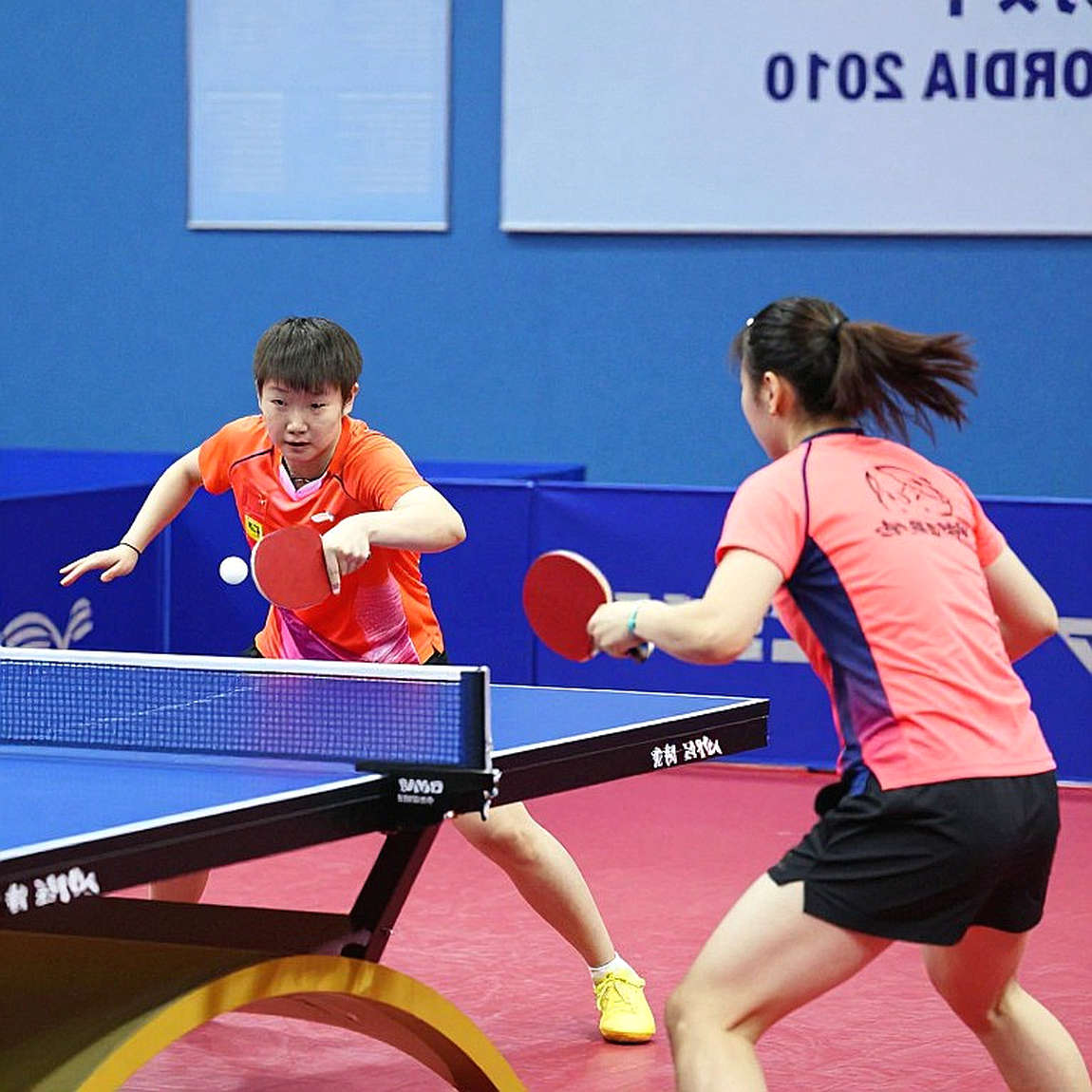
The first three shots — serve, receive and the third ball — decide most points at the elite level. This is a close-range exchange in which everything happens inside about a second. A short backspin serve, a backhand flick played directly at a short ball inside the table, then a heavy topspin. That is the three-beat sequence the world's top players rehearse until it becomes reflex, until they no longer think before striking.
The second pillar is two-winged topspin, which splits into two families. One is pure topspin: heavy ball, high arc, deep landing, forcing the opponent back. The other is loop combined with fast attack — today's dominant two-sided attacking system, blending spin with speed, attacking an opponent's loss of balance rather than raw power.
The third pillar is short-ball backhand handling. Over the past fifteen years, this is where world table tennis has changed most. The backhand flick turned short serves — once a defensive weapon — into easy prey. Players are no longer allowed to serve short for safety.
The fourth pillar is the counter-attacking defensive system. Here lies a particular branch: pips play. Short or long pimpled rubber produces a flat, erratic trajectory that breaks an opponent's rhythm. It is a minority branch of world table tennis, yet in Vietnam it is fairly common, especially in youth cohorts.
And this is where I want to linger a little longer.
Pips play is not an outdated style. It is a tactical choice with its own internal logic, and that logic only holds when attached to a specific human being. A player with quick reflexes but weak wrist power can live very well on pimpled rubber. The problem lies elsewhere: when an entire cohort is taught pips because it easily produces medals at regional level, we are optimising for ranking, not for development.
Tactics are only the shell; inside is the story of a person.
Rubber, blade, and the price of a single change
Equipment is the most underrated variable in any analysis.
Rubber and blade are not accessories. They are part of the technical body. Sponge hardness, tackiness, blade weight and vibration — all of it alters the contact point, the dwell time of the ball on the rubber, and the rebound angle. When a player switches from smooth rubber to pimples, or changes blade, they enter an adaptation period.
How long does that last? For a professional, a few months. For a young player without a stable feel for the ball, possibly a whole year.
In a country with few tournaments, a year is too long. It means losing ranking, losing quota, losing momentum. I have watched young players who were performing well, advised to change equipment to "modernise," vanish from the lists eighteen months later. Nobody calls that an injury. It hurts no less.
Reading a player by what the ranking does not show
People look at the ranking table; I look at the hand waiting for its chance.
A ranking is an aggregate number, and like every aggregate number it conceals more than it reveals. A player ranked fortieth in the world may be the twelfth-best in true strength if he only plays six events a year. Conversely, a player ranked twentieth may be living on expiring points and will fall to fortieth within three months.
Three indicators I always note when tracking a player:
First, the foreign-match win rate. Not the number of wins, but the ratio of wins to total matches against opponents from other associations. This is the true measure of external strength.
Second, consistency at major events. Some players win regional titles steadily but have never passed the second round of a Grand Smash. The distance between those two people is enormous, even if the ranking places them close together.
Third, performance at deciding points. At the elite level, seventy per cent of points are ordinary. The remaining thirty per cent decide the match. A player can win sixty per cent of ordinary points and lose seventy per cent of points at nine-all. Those are two different people.
And there is a dimension the ranking can never measure: head-to-head memory. Table tennis is a sport where one specific style can lock down one specific player for years. Not because the other player is stronger, but because his spin lands precisely on the other's structural weakness.
China and the rest
The world table tennis map has four clear tiers.
The dominant tier is China. This is not a sentimental judgement. World top-ten seats, titles at the last five editions of the three majors, and the depth of the under-twenty-one cohort — all three indicators belong to one country. What matters more is how they sustain it: a domestic circuit strong enough that a player can improve without ever going abroad.
The second tier comprises Japan, South Korea, Germany, Sweden and the Chinese Taipei region. These are table tennis nations with complete development systems and at least one player inside the top twenty.
The third tier is the emerging forces: Brazil, France, Egypt, India. They have a few outstanding individuals but no depth.
Southeast Asia sits at the outer edge of the third tier. Names such as Nguyen Anh Tu, Dinh Quang Linh and Tran Tuan Quynh on the men's side, and Mai Hoang My Trang and Nguyen Khoa Dieu Khanh on the women's side, are the faces who have represented Vietnam at international events. And this is what I want to say clearly, even though it is not easy to hear: we do not lack talent. We lack matches.
When table tennis falls silent, I can finally hear its true pulse.
Decisions nobody sees
There is a layer of analysis Vietnamese sports media barely touches: governance.
How are national team places allocated? Which criteria are quantitative, and which are the coaching staff's intuition? Is a young player who wins the national youth title guaranteed an international quota, or does that quota go to whoever holds the higher ranking?
These questions sound dry, but they decide people's careers. An international quota denied at seventeen can be the end for a player, because at that age every year without competition is a year without learning how to lose to a stranger.
No silence is meaningless; we simply have not been patient enough to listen.
Academies and the generational question
How many dreams does an academy bury, because it only knows how to count money and not how to plant seeds.
The age structure of Vietnamese table tennis has a rarely discussed problem: the average age of national team players is not young, yet the number of under-twenty-one players capable of replacing them is very thin.
This did not happen in a year. It is the result of a decade of choices. When resources are poured into winning medals at regional level, investing in an U15 cohort thick enough to produce three international players five years later becomes a luxury.
The conversion efficiency from youth cohort to national team — what percentage of national youth champions are in the national team four years later — is an indicator I would like to see published. Nobody publishes it.
The risk surface
If I had to draw a risk map for a young Vietnamese table tennis player, I would mark six boxes.
Injury. Wrist, shoulder, lower back, knee. Table tennis looks gentle, but the volume of repetition is enormous.
Technical overhaul. Adjusting a movement that has become reflex can take a season, and results drop during that season.
Equipment change. As discussed above.
Multi-event workload. A player competing in singles, doubles and mixed doubles at the same tournament can play twelve matches in five days.
Selection competition. As discussed above.
Generational vacuum. This is a systemic risk, and the most serious, because no individual can fix it.
Narrative and expectation
Every young player has a story. The problem is that the story is usually written by someone else.
"Prodigy" is a word I propose removing from every sports article. It assigns a responsibility to a child, and it is based on no denominator. A fourteen-year-old who wins a national youth title is not a prodigy. He is a fourteen-year-old boy with good hand mechanics and a patient coach.
What builds a sustainable story? International matches played, the capacity to lose, the move from seventieth to forty-fifth in three years.
What builds a momentary story? One regional medal and three headlines.
I have witnessed both kinds, and I know which one lives longer.
The industry's transmission chain
Table tennis is not only table tennis. It is a chain.
Upstream is equipment and youth development. A change here — a new rubber line, a new academy — takes three to five years to surface in results.
Midstream is tournaments and associations. How they schedule, how they allocate quotas, how they run youth events.
Downstream is broadcasting, commerce and player value. In Vietnam this downstream is very thin. A national player may have no equipment sponsorship at all. That is not merely a money problem. It means nobody is investing in their long-term development, and nobody loses anything if they disappear.
The counter-view: are we inflating, or building?
This is where I want to argue against myself.
There is a weighty argument: Vietnam is a small table tennis nation, and the only way to get results is to concentrate on the arenas it can win. Regional medals bring funding. Funding brings facilities. Facilities bring the next cohort. By that logic, optimising for medals is the rational move.
I understand the logic. I do not believe it.
The problem is this: that causal order only holds if the funding from medals actually flows down to the youth cohorts. In many cases it flows into sustaining the very apparatus that produced the medal — that is, into doing the same thing again with the next cohort.
Pressure does not kill an athlete; it exposes their true nature.
And when a system is measured only by medals in one region, it will forever be good only in that region.
What I brought back from the third row
The boy who served with pimpled rubber that day still has no name on any ranking list. I do not know where he will end up. The probability that a young player at this stage reaches the national team is small. The probability that he has a stable international career is smaller still. The probability that he quits before twenty is the highest of all.
But I wrote it down anyway. Because most forgotten players are not forgotten for losing. They are forgotten because nobody recorded the moment they began.
If I have one proposal for Vietnamese table tennis, it is not to change the coach or raise the budget.
It is: count again.
Count how many players in an U15 cohort compete internationally each year. Count how long a national youth champion takes to reach the national team. Count how many quit, and why.
Those numbers will not bring medals immediately. But they are the only thing that lets us know whether we are winning for real, or winning inside a small room.
And if in ten more years nobody counts, the boy in the third row will still be sitting there, bending to pick up the ball, wiping the rubber with the back of his hand, walking to the end line — winning a point nobody applauds.

Cầu thủ liên quan
Bài nổi bật
SBCL Premier Division Weekend 1: When Four Players Totalling 71 Years Beat a Former Champion2026-09-29
2026 European Individual Championships: The 28 September Deadline and the Ranking Clause Worth Reading2026-09-28
The 2026 U.S. Open: 118 Events, One Deadline, and the Question of What a National Championship Really Is2026-09-27
2026 U.S. Open: Inside the 118-Event Machine and the Membership Gate2026-09-27
118 Events, Six Days, and a Gap: What the 2026 U.S. Open Says About American Table Tennis2026-09-27
2026 U.S. Open Table Tennis: Vegas Builds a Stage for the Unnamed2026-09-26
The 2026/27 BCL Opening Weekend: Ormesby, Debutants DHS Hurricane Kingsway, and the Race Behind British Table Tennis2026-09-25
Bài đề xuất
World Table Tennis After Paris 2026: The Real Battle the Data Is Drawing2026-09-16
2026 European Individual Championships: The 28 September Deadline and the Ranking Clause Worth Reading2026-09-28
Table Tennis, an Empty Data File, and the Discipline of Not Making Things Up2026-09-20
2026 U.S. Open: Inside the 118-Event Machine and the Membership Gate2026-09-27
Eurotalents Camp in Luxembourg: China Exports Its Methods — and Its Six Sparring Partners2026-09-17
Bayley and Davies Lead GB Squad to France: 12 Names, 8 Weeks and a Seeding Gamble2026-09-28
Gangneung, Ten Days and 11 European Players: What a Cross-Continental Training Camp Actually Measures2026-09-19
Bài đề xuất
51st Balkan Table Tennis Championships: Vladislav URSU's Triple Crown and the Limits of a Results Sheet2026-09-23
Table Tennis, an Empty Data File, and the Discipline of Not Making Things Up2026-09-20
SBCL Premier Division Weekend 1: When Four Players Totalling 71 Years Beat a Former Champion2026-09-29
Southeast Asian Youth Table Tennis: Talent Buried Beneath the Sediment of Data2026-09-16
Bayley and Davies Lead GB Squad to France: 12 Names, 8 Weeks and a Seeding Gamble2026-09-28
Nine Layers of Table Tennis Analysis: When the Data Comes Back Empty2026-09-25
Braintree: Reading the Pre-Season Table Like a Fault Map2026-09-29
Bài đề xuất
Bayley and Davies Lead GB Squad to France: 12 Names, 8 Weeks and a Seeding Gamble2026-09-28
Reading the Gaps Behind the Serve: Why China's Table Tennis Wall Still Stands2026-09-29
2026 U.S. Open Table Tennis: Vegas Builds a Stage for the Unnamed2026-09-26
ETTU and Dyn sign broadcast partnership through 2028: Europe's table tennis rights map is redrawn from Ljubljana2026-09-26
Belgium Open 2026: Portugal's Double U21 Crown and the Crack That Isn't on the Trophy2026-09-20
Vietnamese Table Tennis and the Midnight Call: Where the Transfer Market Has Never Existed2026-09-21
The First Three Shots: Dissecting the Gaps in Vietnamese Table Tennis2026-09-30